David Jones, artist and poet (1895-1974) begins his PREFACE TO THE ANATHEMATA :
'I have made a heap of all that I could find.' (1) So wrote Nennius, or whoever composed the introductory matter to Historia Brittonum. He speaks of an 'inward wound' which was caused by the fear that certain things dear to him 'should be like smoke dissipated'. Further, he says, 'not trusting my own learning, which is none at all, but partly from writings and monuments of the ancient inhabitants of Britain, partly from the annals of the Romans and the chronicles of the sacred fathers, Isidore, Hieronymous, Prosper, Eusebius and from the histories of the Scots and Saxons although our enemies . . . I have lispingly put together this . . . about past transactions, that [this material] might not be trodden under foot'. (2)
(1) The actual words are coacervavi omne quod inveni, and occur in Prologue 2 to the Historia.
(2) Quoted from the translation of Prologue 1. See The Works of Gildas and Nennius, J.A.Giles, London 1841.
(1) The actual words are coacervavi omne quod inveni, and occur in Prologue 2 to the Historia.
(2) Quoted from the translation of Prologue 1. See The Works of Gildas and Nennius, J.A.Giles, London 1841.
19 April 2009
18 April 2009
M (for Fritz Lang)
.
Today's image (conceived at St Peter's, Rome, in 1988; screen- printed at Berlin in 1992; and over-painted with a red M at Hepburn Springs in 1995) is dated -1995- and inscribed for Fritz Lang, after his 1931 film M.

Today's image (conceived at St Peter's, Rome, in 1988; screen- printed at Berlin in 1992; and over-painted with a red M at Hepburn Springs in 1995) is dated -1995- and inscribed for Fritz Lang, after his 1931 film M.

08 April 2009
M for Me, My, Mind, Mirror, Mired, Marked, Murder, Madness, Monolog (and more...)
.
Yesterday's image came from an autographed audio LP cover.
Today's is from a film, Fritz Lang's M (1931).
In the previous image the woman before the mirror asks herself:
"What would people say if I let them see the real me?"
In M, the chalk-marked murderer at the end of a pleading monolog reverses this question and addresses it to all who would judge him:
"Who knows what it's like to be me?
An obvious third to recall here is Rene Magritte's widely known Not to be Reproduced (La reproduction interdite), 1937.
Unlike the first two, no formal question accompanies it other than Magritte's clever title and our interrogative self-talk in response.
What is chance? By chance, last night I started on the latest Mandala magazine.
In it's opening article, Appearance and Illusion, the late Lama Yeshe (above) suggests another mirror practice :
Yesterday's image came from an autographed audio LP cover.
Today's is from a film, Fritz Lang's M (1931).
In the previous image the woman before the mirror asks herself:
"What would people say if I let them see the real me?"
In M, the chalk-marked murderer at the end of a pleading monolog reverses this question and addresses it to all who would judge him:
"Who knows what it's like to be me?
An obvious third to recall here is Rene Magritte's widely known Not to be Reproduced (La reproduction interdite), 1937.
Unlike the first two, no formal question accompanies it other than Magritte's clever title and our interrogative self-talk in response.
. . . .
What is chance? By chance, last night I started on the latest Mandala magazine.
In it's opening article, Appearance and Illusion, the late Lama Yeshe (above) suggests another mirror practice :
... If you have realized the reality of non-self-existence, if somebody praises you, prostrates to you and anoints you with perfume while another criticizes you, complains about you or even beats you, you have the space of mind to maintain balance. Why is there space? Have you no mind? Are you out of your mind? Have you lost all feeling? Are you no longer human? Western intellectuals might question me like this. No – you have universal consciousness. What you have lost is the attitude of fanatical, extreme, dualistic grasping. That mind has disappeared.
We lamas have a technique for practicing this kind of detachment. You look at your reflection in a mirror and imagine two people, one hurling insults at the you in the mirror, the other praising and trying to please your reflection as much as possible. As you might expect, the you in the mirror pays attention to neither of them. Now, you’re going to argue that of course the reflection doesn’t respond; it has no mind. There’s no reason for it to be happy or unhappy. But this is not an exercise in logic; this is the lamas’ scientific technique for training our minds to overcome the eight worldly dharmas. Try it out for yourself; you’ll see that it works.
Lama Thubten Yeshe
Extract from Appearance and Illusion, a teaching given at Manjushri Institute, England, August 1977. Published in Mandala : April/June 2009)
07 April 2009
05 April 2009
Stenciled on the Void
.
AN INGENIOUS device which paints signs on the sidewalks, but which in no way permanently defaces the street, is the instrument of choice for this anonymous street artist. To paint and publish his meta-text to all he has constructed a large rolling drum filled with water and enveloped in a stencil scroll. As the drum rolls along the water emerges around the stencil and paints an outline of the letters on the walk. The water evaporates in a short time, so no damage is done. Though his poem cannot be effectively painted on a rainy day, this enigmatic character is often seen at his task during the heaviest of downpours.


03 April 2009
BLACK MIRROR, Gail Jones
.
A note inside my copy of Gail Jones' BLACK MIRROR records
the following :
BLACK MIRROR, Gail Jones, page 211 :
BLACK MIRROR, Gail Jones, page 213 :
One more scanning schema : this time a light box is placed over the object. Yes, it effectively obviates a heavy shadow registering at the base of the book, but its fluoro lights produce a muddy yellow-green-blue white so I've desaturated and lightened that section of the image.
A note inside my copy of Gail Jones' BLACK MIRROR records
the following :
- Wed 19 March 2003 -
I'm sitting in Borders bookshop in Carlton, Melb
looking at a copy of "Black Mirror" by Gail Jones
having heard a very interesting interview with her
a few hours ago on ABC.RN
A man on a mobile phone walks by. He says,
"... it needed some new fat tyres and so on,
so I thought 'Damn it, I'll get a new one' ...
It's a black, a metallic sort of black...
yes, that's right, it's Melbourne..."
BLACK MIRROR, Gail Jones, page 211 :
THE BLACK MIRROR STORIES
Music that arises out of abandoned places
Your space is under the earth, inside the earth,
inside the stars.
Where do images go?
Why does a mirror gather light for thirty years
and then hold nothing?
(Peter Boyle, Light From Beyond)
BLACK MIRROR, Gail Jones, page 213 :
Victoria said:
I have several Black Mirror stories and I will give you three.
What are the Black Mirror stories, my Anna-lytical?
They are myself, unrecognisable. They are myself, writing disaster. I looked into a miror and darkness looked back.
One more scanning schema : this time a light box is placed over the object. Yes, it effectively obviates a heavy shadow registering at the base of the book, but its fluoro lights produce a muddy yellow-green-blue white so I've desaturated and lightened that section of the image.
02 April 2009
BLACK MIRROR
.
Schrödinger's g_d was yesterday's headline.
It could just as well have been Black Light or Black Mirror or Jimi Hendrix' great triple negative wail from the abyss (No sun coming through my windows, feel like I'm living at the bottom of a grave) Oh there ain't no light nowhere.
BLACK MIRROR: REFLECTIONS IN GLOBAL MUSICS (1918-1954) [more at Dust-To-Digital] has just arrived. It was ordered two weeks ago, before this sequence of posts was conceived.
Following yesterday's speculations, I have scanned it with the lid open, not with a black background overlaid, and not with a mirror to reflect the light, so the black background in the image (below) is a depiction of the absence of the scanner's emitted light. Continuing the empirical review, it has been scanned cocooned still in it's cellophane wrapper. The blue-white flares are the full light of the scanner reflected back. But wait, isn't that like a mirror-return?
01 April 2009
Schrödinger's g_d
.
From time to time I give some thought to the shadow cast by the scanner's light as it moves from one end of its field to the other.
If a sheet of black material is placed over an object-to-be-scanned then the scanned image will appear with a black background. Similarly, if a white cover is used a white background is the result.
However, if one does use a white background the scanner's light will cast a shadow from the-object-being-scanned onto the white field. Even from a white-on-white paper's edge.
Sometimes this shadow is inconvenient, and to remove or obviate it can require a deal of secondary scanning : after the first scan the object is rotated 180 degrees and then re-scanned from the other direction, as it were. The shadows are then absent from their original locations but appear instead at the opposite, previously shadowless edges. These two scans from opposite directions are then melded and finessed to exclude any unwanted shadow.
It had occurred to me that one might be able to achieve a shadowless image in a single pass if a mirror, instead of a sheet of white paper, was placed over the object-to-be-scanned. Again some observations: if one places no cover over the object-to-be-scanned, that is if one leaves the flatbed scanner lid open, then usually the resultant scan shows an unfocused dull background or, if the room is dark, a black background behind the object scanned. And, to reiterate, if one uses a white background cover one gets a white background scan.
Putting these observations together I imagined that a sheet of mirror laid onto the scanner bed would reflect back and thus digitally picture the scanner's own bright white light. The only problem anticipated was that the light, being so relatively bright, might appear to bleed or fog a little around the edges of the object-to-be-scanned. I certainly did not anticipate this result:
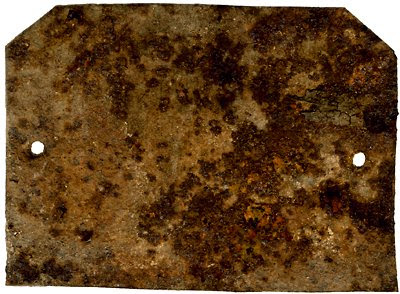
The image above is a screen snap of the preview scan (and the actual scan produced the same) : upon the scanner's glass is the unearthed corroded label, the intended object-to-be-scanned; around that, plus some, the 'marching ants' frame that indicates the area to be scanned; within that, as well as the old label, appears a blue finger print. The latter certainly provides a clue or two (including from the Tyndall Effect) as to why the background appears as black rather than the white I expected.
The scanner's recorder of evidence appears to respond only to a partial return of its search light, as with the dis-scribed Label and the greasy finger mark, but not to recognise the light's total unmediated return from the surface of the selfless mirror.
Light from the Sun reveals the Moon to our eyes. If beside the illuminated Moon there also orbited a vast flat mirror, and if that mirror was angled correctly would we not see the bright light of the Sun reflected to illuminate our stardust bodies as well? Just how eye-like is a camera or scanner? We know we must not look directly at the Sun: it's radiance is too intense for our jelly optics and can destroy our sight. Rather, we must observe it indirectly, as it illuminates our surrounds. (Moses returns from the mountain, unconscious of his blinding luminescence, and is asked to wear a veil.) Lost in fact, adrift in analogy, feeling primitive.
This familiar and ancient speculation set: a source of light; something to be shone upon; the shadow component too; a cave wall projection-theatre; a mirror; some labels; the ____; a ____; observer/s...
If one expects a certain result
one may experience an unexpected result
In front of me a keyboard,
above that a monitor on which
[ "In front of me... "]
To my right a mouse,
to my left a scanner/
HA HA
above that a monitor on which
[ "In front of me... "]
To my right a mouse,
to my left a scanner/
HA HA
From time to time I give some thought to the shadow cast by the scanner's light as it moves from one end of its field to the other.
If a sheet of black material is placed over an object-to-be-scanned then the scanned image will appear with a black background. Similarly, if a white cover is used a white background is the result.
However, if one does use a white background the scanner's light will cast a shadow from the-object-being-scanned onto the white field. Even from a white-on-white paper's edge.
Sometimes this shadow is inconvenient, and to remove or obviate it can require a deal of secondary scanning : after the first scan the object is rotated 180 degrees and then re-scanned from the other direction, as it were. The shadows are then absent from their original locations but appear instead at the opposite, previously shadowless edges. These two scans from opposite directions are then melded and finessed to exclude any unwanted shadow.
It had occurred to me that one might be able to achieve a shadowless image in a single pass if a mirror, instead of a sheet of white paper, was placed over the object-to-be-scanned. Again some observations: if one places no cover over the object-to-be-scanned, that is if one leaves the flatbed scanner lid open, then usually the resultant scan shows an unfocused dull background or, if the room is dark, a black background behind the object scanned. And, to reiterate, if one uses a white background cover one gets a white background scan.
Putting these observations together I imagined that a sheet of mirror laid onto the scanner bed would reflect back and thus digitally picture the scanner's own bright white light. The only problem anticipated was that the light, being so relatively bright, might appear to bleed or fog a little around the edges of the object-to-be-scanned. I certainly did not anticipate this result:
The image above is a screen snap of the preview scan (and the actual scan produced the same) : upon the scanner's glass is the unearthed corroded label, the intended object-to-be-scanned; around that, plus some, the 'marching ants' frame that indicates the area to be scanned; within that, as well as the old label, appears a blue finger print. The latter certainly provides a clue or two (including from the Tyndall Effect) as to why the background appears as black rather than the white I expected.
The scanner's recorder of evidence appears to respond only to a partial return of its search light, as with the dis-scribed Label and the greasy finger mark, but not to recognise the light's total unmediated return from the surface of the selfless mirror.
Light from the Sun reveals the Moon to our eyes. If beside the illuminated Moon there also orbited a vast flat mirror, and if that mirror was angled correctly would we not see the bright light of the Sun reflected to illuminate our stardust bodies as well? Just how eye-like is a camera or scanner? We know we must not look directly at the Sun: it's radiance is too intense for our jelly optics and can destroy our sight. Rather, we must observe it indirectly, as it illuminates our surrounds. (Moses returns from the mountain, unconscious of his blinding luminescence, and is asked to wear a veil.) Lost in fact, adrift in analogy, feeling primitive.
This familiar and ancient speculation set: a source of light; something to be shone upon; the shadow component too; a cave wall projection-theatre; a mirror; some labels; the ____; a ____; observer/s...
28 March 2009
More from the Lost History of Kelly and the AntiModeans (for Bernard Smith)
.
modean (see also: modern)
[mod⋅ean]
–adjective
–noun
Origin:
modean (see also: modern)
[mod⋅ean]
–adjective
| 1. | of or pertaining to present and recent time; not ancient or remote: modean city life. |
| 2. | characteristic of present and recent time; contemporary; not antiquated or obsolete: modean viewpoints. |
| 3. | of or pertaining to the historical period following the Middle Ages: modean European history. |
| 4. | of, pertaining to, or characteristic of contemporary styles of art, literature, music, etc., that reject traditionally accepted or sanctioned forms and emphasize individual experimentation and sensibility. |
| 5. | (initial capital letter) new (def. 12). |
| 6. | Typography. noting or descriptive of a font of numerals in which the body aligns on the baseline, as 1234567890. Compare old style (def. 3). |
–noun
| 7. | a person of MODEAN TIMES |
| 8. | a person whose views and tastes are modean. |
| 9. | Printing. a type style differentiated from old style by heavy vertical strokes and straight serifs. |
Origin:
1490–1500; < class="ital-inline">moderne < class="ital-inline">moderna, equiv. to L mod(o), mod(ō) lately, just now (orig. abl. sing. of modus mode 1 ) + -erna adj. suffix of time
TODAY:
Kelly Meets His Maker
TODAY:
Kelly Meets His Maker
25 March 2009
Old Label
Subscribe to:
Posts (Atom)