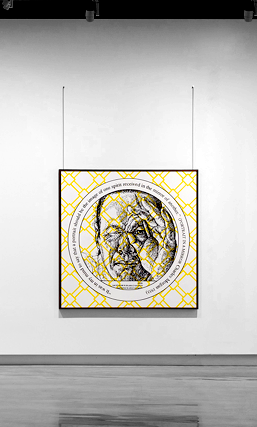
David Jones, artist and poet (1895-1974) begins his PREFACE TO THE ANATHEMATA :

'I have made a heap of all that I could find.' (1) So wrote Nennius, or whoever composed the introductory matter to Historia Brittonum. He speaks of an 'inward wound' which was caused by the fear that certain things dear to him 'should be like smoke dissipated'. Further, he says, 'not trusting my own learning, which is none at all, but partly from writings and monuments of the ancient inhabitants of Britain, partly from the annals of the Romans and the chronicles of the sacred fathers, Isidore, Hieronymous, Prosper, Eusebius and from the histories of the Scots and Saxons although our enemies . . . I have lispingly put together this . . . about past transactions, that [this material] might not be trodden under foot'. (2)

(1) The actual words are coacervavi omne quod inveni, and occur in Prologue 2 to the Historia.
(2) Quoted from the translation of Prologue 1. See The Works of Gildas and Nennius, J.A.Giles, London 1841.


Showing posts with label mirror. Show all posts

03 May 2022

TAR of Babel

   
Theatre of the Ancients of Regard 
 detail
 A Person Looks At A Work Of Art/
 someone looks at something...
  
 LOGOS/HA HA


01 July 2021

Archibald Prize for Portraiture : 100 Years of


"Show me your original face before your mother and father were born."


You cannot describe it, you cannot picture it,
You cannot admire it, you cannot sense it.
It is your true self, it has nowhere to hide.
When the world is destroyed, it will not be 
   destroyed.

- Mumon, The Gateless Gate #23 (1288) 
   Do Not Think Good, Do Not Think Not-Good

 .  .  .  .         

2021 is the 100th year of the Art Gallery of New South Wales' Archibald Prize for portraiture.

From the 6000 portraits exhibited as finalists over the past century, cold case detectives at AGNSW have identified 100 of these for a Portrait of the Nation two year Tour of Shame : Archie 100

AAA : Art Archive Australia  

"There are eight million stories in the naked city. This is one of them."

- NAKED CITY (1958-1963)

Signed Confession :

"It was in my mind to say that a portrait should be the image of one spirit received in the mirror of another"

- PORTRAIT IN A MIRROR, Charles Morgan (1933)

Suspended Sentence : TAR co-portrait (-1991-)    

Known Associates :

2018.03 Michael Buxton and Charles Justin

collection : Buxton Contemporary, Melbourne  
Last seen :

Art Gallery of New South Wales
    5 June – 26 September 2021
Geelong Gallery
    6 November 2021 – 20 February 2022
Cairns Art Gallery
    18 March – 12 June 2022
Art Gallery of South Australia
    9 July – 2 October 2022
Queen Victoria Museum and Art Gallery, Launceston
    24 October 2022 – 8 January 2023
Bathurst Regional Art Gallery
    26 January – 26 March 2023
Museum and Art Gallery of the Northern Territory
    15 April – 25 June 2023
Home of the Arts, Gold Coast
    15 July – 2 October 2023
National Portrait Gallery, Canberra
    21 October 2023 – 28 January 2024

Theatre of the Actors of Regard 
 detail
 A Person Looks At A Work Of Art/
 someone looks at something...
  
 LOGOS/HA HA


13 February 2021

Lindy Lee at MCA


Lindy Lee : Moon in a Dew Drop

A major survey exhibition

MCA Sydney

2 Oct 2020 – 28 Feb 2021

 MCA forecourt with 'Secret World of a Starlight Ember' by
 Lindy Lee, 2020 - photo by Anna Kucera
Theatre of the Actors of Regard   
 detail
 A Person Looks At A Work Of Art/
 someone looks at something...
  
 LOGOS/HA HA


03 August 2020

Self and Other | Fight Club


 Susie, our hard-working Assistant Editor 

 likes to spar with Appearance & Illusion.


Theatre of the Actors of Regard  
 detail
 A Person Looks At A Work Of Art/
 someone looks at something...
  
 LOGOS/HA HA


01 May 2020

TAR 2x]glass+ssalg(÷2

Colin McCahon, 1948

Theatre of the Actors of Regard  
 detail
 A Person Looks At A Work Of Art/
 someone looks at something...
  
 LOGOS/HA HA


29 April 2020

glass half TAR


Theatre of the Actors of Regard  
 detail
 A Person Looks At A Work Of Art/
 someone looks at something...
  
 LOGOS/HA HA


10 January 2020

Concept of Permanence


Gauging the Possibilities of Impermanence at the New MoMA

MoMA’s recent expansion embodies the tension between the ways in which cultural spaces can offer visitors comfortable narratives and on the other, how they can suggest the potential for radical inclusiveness by iteration, reinvention, and reinstallation.

 Laura Raicovich   January 9, 2020

 Read article
 HERE


The Perm is Back


 Ali Oshinsky (below with perm)   February 2019 

 Read article
 HERE
  
Theatre of the Actors of Regard  
 detail
 A Person Looks At A Work Of Art/
 someone looks at something...
  
 LOGOS/HA HA


06 January 2020

Making mochi in Hell


  Making mochi in Hell                                   collection : FIAPCE
The first recorded accounts of mochi being used as a part of New Year's festivities are from the Japanese Heian period. The nobles of the imperial court believed that long strands of freshly made mochi symbolized long life and well-being, while dried mochi helped strengthen one's teeth. Accounts of it can also be found in the oldest Japanese novel, The Tale of Genji.
Mochi continues to be one of the traditional foods eaten around Japanese New Year, as it is sold and consumed in abundance around this time. A special type, called kagami mochi (mirror mochi), is placed on family altars on December 28 each year. Kagami mochi is composed of two spheres of mochi stacked on top of one another, topped with an orange (daidai).    On this occasion, which was originally practiced by the samurai, the round rice cakes of kagami mochi would be broken, thus symbolizing the mirror's opening and the ending of the New Year's celebrations. (Wikipedia)


click images for info  
 detail
 A Person Looks At A Work Of Art/
 someone looks at something...
  
 LOGOS/HA HA


09 October 2019

Self-portrait as Return To Sender : Delivered/Undeliverable/Signature Required


Today, we received two noteworthy photographic images of reflexive regard. 

The first via an academia.edu alert for an article by Jacquelynn Baas : 'Marcel Duchamp and the Artist of Tomorrow' (Interalia Mag. issue 3, 2014)


 Marcel Duchamp (American, b. France, 1887-1968). Details of 
 To Be Looked at (from the Other Side of the Glass) with 
 One Eye, Close to, for Almost an Hour, 1918. 
 Oil, silver leaf, lead wire, and magnifying lens on glass, 
 mounted in a standing metal frame, 20 1/8 x 16 x 1 3/8 inches. 
 Museum of Modern Art (New York) Katherine S. Dreier Bequest
 Photo: Jacquelynn Baas.

The second image via Marcus Bunyan's Art Blart :
  

 Aenne Biermann (1898-1933)
 Self-Portrait with Silver Ball
 1931
 Gelatin silver print
 Museum für Kunst und Gewerbe, Hamburg

Theatre of the Actors of Regard  
 detail
 A Person Looks At A Work Of Art/
 someone looks at something...
  
 LOGOS/HA HA


02 September 2019

o::::::::::::::::::::::::::::::::::::::::::::::::::::::::::::o


See-See
Saw
Law of the Lever
Lever of the Law


click image to enlarge  
Hotei and the TARist
after Shōkadō Shōjō
1584-1639


Theatre of the Actors of Regard  
 detail
 A Person Looks At A Work Of Art/
 someone looks at something... 
         
 LOGOS/HA HA


28 May 2019

The Art of Camouflage | Move on, please. Nothing to be seen here.


 etymoLOGOS/HA HA 

Borrowed from French camouflage, from camoufler (“to veil, disguise”), alteration (due to camouflet "smoke blown in one's face") of Italian camuffare (“to muffle the head”), from ca- (from Italian capo (“head”)) + muffare (“to muffle”), from Medieval Latin muffula, muffla (“muff”), from Frankish *molfell (“soft garment made of hide”) from *mol (“softened, forworn”) (akin to Old High German molawēn (“to soften”), Middle High German molwic (“soft”)) + *fell (“hide, skin”), from Proto-Germanic *fellą (“skin, film, fleece”), from Proto-Indo-European *pel(e)(w)-, *plē(w)- (“skin, hide”). Akin to Old High Germanfel (“fell, skin, hide”), Old English fell (“fell, skin, hide”). Alternate etymology traces the Italian and Medieval Latin words to Middle High German mouwe, mōwe (“sleeve”) (German Muff (“muff”), Dutch mouw (“sleeve”)) from Proto-Germanic *mawwō (“sleeve”) + fell (“skin”). More at mulch, fell.


 Theatre of the Army of Regard  
  detail 
  A Person Looks At A Work Of Art/ 
  someone looks at something... 

  LOGOS/HA HA 


25 March 2019

A Centre for Everything | Shapes of Knowledge


Wednesday 27 March, 1-2pm
G104, Building G
Monash Art, Design and Architecture
Monash University, Caulfield Campus
FREE /// All welcome


A Centre for Everything will discuss their project for MUMA’s international group exhibition Shapes of Knowledge in relation to global shifts in art and activism that have influenced their work. Maps of Gratitude, Cones of Silence and Lumps of Coal explores how the fossil fuel industry ingratiates itself to the Australian public. The project adopts A Centre for Everything’s signature triadic formation, bringing together the topics of Ice Coal, Data Networks and Collective Activity to converge in generative and revealing ways.
A Centre for Everything is an independent creative and pedagogical project that engages individuals and communities to learn, create, discuss and eat together founded by artists Will Foster and Gabrielle de Vietri. Their collaborative events bring together diverse topics through performances, presentations, workshops, readings, discussions, demonstrations, critiques and meals. Recurring themes include active responses to current political issues, game-play and its application to wider modes of social behaviour, collective creativity, and the intersection of artistic, social and pedagogical thinking.
A Centre for Everything are participating in Shapes of Knowledge at Monash University Museum of Art, 9 February – 13 April 2018.

 Image: A Centre for Everything, Solar circles, Crepe circles & 
 Munari’s circles 2015.

 detail
 A Person Looks At A Work Of Art/
 someone looks at something... 
         
 LOGOS/HA HA


18 October 2018

Vale Alan Abel


Alan Abel, Hoaxer Extraordinaire, Is            (on Good Authority) Dead at 94

 click image to enlarge    

Theatre of the Actors of Regard    
detail
A Person Looks At A Work Of Art/
someone looks at something... 
         
LOGOS/HA HA


27 June 2018

Antipodean re. View


Theatre of the Actors of Regard       
 detail
 A Person Looks At A Work Of Art/
 someone looks at something... 
         
 LOGOS/HA HA

Theatre of the Actors of Regard enjoyed the epilog scene in Sebastian Smee's review of Baselitz: Six Decades at the Hirshhorn Museum, Washington:

'Whatever. The comedy of watching art aficionados standing in front of these canvases and trying to resist the urge to turn their heads upside down, the better to see them, is a consolation, of sorts.'

Georg Baselitz is an overrated hack. Art collectors fell for him - but you don’t have to.
Sebastian Smee | The Washington Post

24 June 2018
     
Theatre of the Antipodean Regard  
 detail
 A Person Looks At A Work Of Art/
 someone looks at something... 
         
 LOGOS/HA HA


20 March 2018

See See Writer


c c

The term power was used by the Greek mathematician Euclid for the square of a line.[1] Archimedes discovered and proved the law of exponents, 10a 10b = 10a+b, necessary to manipulate powers of 10.[2] In the 9th century, the Persian mathematician Muhammad ibn Mūsā al-Khwārizmī used the terms mal for a square and kahb for a cube, which later Islamic mathematicians represented in mathematical notation as m and k, respectively, by the 15th century, as seen in the work of Abū al-Hasan ibn Alī al-Qalasādī.3

In the late 16th century, Jost Bürgi used Roman numerals for exponents.[4]

Early in the 17th century, the first form of our modern exponential notation was introduced by Rene Descartes in his text titled La Géométrie; there, the notation is introduced in Book I.[5]

Nicolas Chuquet used a form of exponential notation in the 15th century, which was later used by Henricus Grammateus and Michael Stifel in the 16th century. The word "exponent" was coined in 1544 by Michael Stifel.[6] Samuel Jeake introduced the term indices in 1696.[7]  In the 16th century Robert Recorde used the terms square, cube, zenzizenzic (fourth power), sursolid (fifth), zenzicube (sixth), second sursolid (seventh), and zenzizenzizenzic (eighth).[7] Biquadrate has been used to refer to the fourth power as well.

Some mathematicians (e.g., Isaac Newton) used exponents only for powers greater than two, preferring to represent squares as repeated multiplication. Thus they would write polynomials, for example, as ax + bxx + cx3 + d.

Another historical synonym, involution,[8] is now rare and should not be confused with its more common meaning.

In 1748 Leonhard Euler wrote "consider exponentials or powers in which the exponent itself is a variable. It is clear that quantities of this kind are not algebraic functions, since in those the exponents must be constant."[9] With this introduction of transcendental functions, Euler laid the foundation for the modern introduction of natural logarithm as the inverse function for the natural exponential function, f(x) = ex.


- wikipedia


 Wassily Kandinsky, Der Blaue Reiter, 1903

c

see see

"See See Rider", also known as "C.C. Rider", "See See Rider Blues" or "Easy Rider", is a popular American 12-bar blues song, originally recorded by Gertrude "Ma" Rainey in 1924. The song uses mostly traditional blues lyrics to tell the story of an unfaithful lover, commonly called an easy rider: "See see rider, see what you have done," making a play on the word see and the sound of easy.

Origins of the term : The term see see rider is usually taken as synonymous with easy rider. In dirty blues songs it often refers to a woman who had liberal sexual views, had been married more than once, or was skilled at sex. Although Ma Rainey's version seems to refer to "See See Rider" as a man, one theory is that the term refers to a prostitute and in the lyric "You made me love you, now your man done come," "your man" refers to the woman's pimp. So, rather than being directed to a male "easy rider," the song is in fact an admonition to a prostitute to give up her evil ways.[11] [12]

There are further theories:
- Easy rider was sometimes used to refer to the partner of a hypersexual woman who therefore does not have to work or pay for sex
.[11] [12]
- Another theory is that the term easy rider sometimes originally referred to the guitar hung across the back of a travelling blues singer
.[13]
- Other sources indicate that C.C. Rider refers to either early "church circuit" traveling preachers who did not have established churches or "county circuit" riders who were attorneys following a circuit judge
.[14] [15]

- wikipedia


cc cc

see see see see


This traditional blues song was originally recorded as 'C.C. Rider' by William Lee Conley, or as he was better known, Big Bill Broonzy, in the 1920s. Ma Rainey made it popular in 1925 as the 'See See Rider Blues', and both Ma Rainey and Big Bill's versions are much slower than Elvis' version.

Once rock bands took a hold of the song, they sped it up a bit. Both The Animals and Mitch Ryder & The Detroit Wheels covered the song (as both 'See See' and 'C.C'. respectively). LaVern Baker's 1962 version is sped up, too, but it's also bluesy.

Elvis' version is maybe the most energetic version of them all.

   - For Elvis Fans Only


see : Wayne Cochran & the C.C. Riders

see : cc Theatre of the Actors of Regard
  
meta-punitive exponentiation meta-unitive exponentiation
Theatre of the Actors of Regard  
detail
A Person Looks At A Work Of Art/
someone looks at something... 
         
LOGOS/HA HA