David Jones, artist and poet (1895-1974) begins his PREFACE TO THE ANATHEMATA :
'I have made a heap of all that I could find.' (1) So wrote Nennius, or whoever composed the introductory matter to Historia Brittonum. He speaks of an 'inward wound' which was caused by the fear that certain things dear to him 'should be like smoke dissipated'. Further, he says, 'not trusting my own learning, which is none at all, but partly from writings and monuments of the ancient inhabitants of Britain, partly from the annals of the Romans and the chronicles of the sacred fathers, Isidore, Hieronymous, Prosper, Eusebius and from the histories of the Scots and Saxons although our enemies . . . I have lispingly put together this . . . about past transactions, that [this material] might not be trodden under foot'. (2)
(1) The actual words are coacervavi omne quod inveni, and occur in Prologue 2 to the Historia.
(2) Quoted from the translation of Prologue 1. See The Works of Gildas and Nennius, J.A.Giles, London 1841.
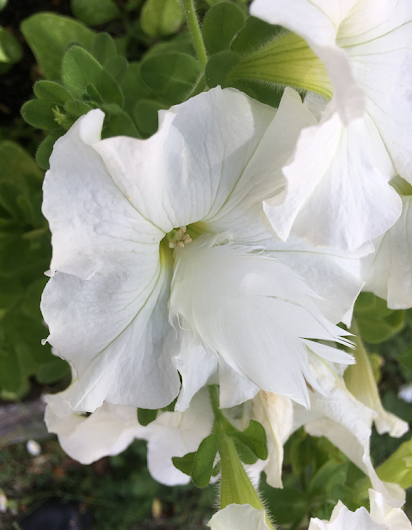
A cover version of yesterday’s “Flower Sermon” in which one of the actors was a percussionist. for Margaret Plant 
Theatre of the Actors of Regard
detail
A Person Looks At A Work Of Art/
someone looks at something...
LOGOS/HA HA
A F E A T H E R O N T H E B R E A T H O F G O D
A F E A T H E R O N T H E L O G O S / H A H A
A N D V O I C I F L O S S I E F L O S D E A
Theatre of the AnthoLOGOS/HA HA of Regard
detail
A Person Looks At A Work Of Art/
someone looks at something...
LOGOS/HA HA
a World in a Grain of Sand And a Heaven in a Wild Flower
- William Blake, the opening lines of Auguries of Innocence
Painting on silk, 9.2 x 4.3 cm. Toyok, 8th-9th century.
(Ethnic Uighurian region in Northwestern China)
Museum fur Indische Kunst (MIK III 6348)
The Flower Sermon is a story of the origin of Zen Buddhism in which Gautama Buddha transmits direct prajñā (wisdom) to the disciple Mahākāśyapa. In the original Chinese, the story is Niān huā wēi xiào (拈花微笑, literally "Pick up flower, subtle smile").
In the story, the Buddha gives a wordless sermon to his disciples (sangha) by holding up a white flower. No one in the audience understands the Flower Sermon except Mahākāśyapa, who smiles. Within Zen, the Flower Sermon communicates the ineffable nature of tathātā (suchness) and Mahākāśyapa's smile signifies the direct transmission of wisdom without words. The Buddha affirmed this by saying:
I possess the true Dharma eye, the marvelous mind of Nirvana, the true form of the formless, the subtle [D]harma [G]ate that does not rest on words or letters but is a special transmission outside of the scriptures. This I entrust to Mahākāśyapa.[1]
One day the Buddha silently held up a flower before the assembled throng of his disciples. This was the famous "Flower Sermon." Formally speaking, much the same thing happened in Eleusis when a mown ear of grain was silently shown. Even if our interpretation of this symbol is erroneous, the fact remains that a mown ear was shown in the course of the mysteries and that this kind of "wordless sermon" was the sole form of instruction in Eleusis which we may assume with certainty.[2]
A Person Looks At A Work Of Art/
someone looks at something...
LOGOS/HA HA


Theatre of the Actors of Regard
detail
A Person Looks At A Work Of Art/
someone looks at something...
LOGOS/HA HA
click image to enlarge
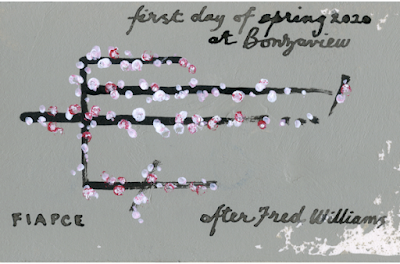
Theatre of the Actors of Regard
detail
A Person Looks At A Work Of Art/
someone looks at something...
LOGOS/HA HA
Hyakka Ryōran (百花繚乱) is a Japanese phrase meaning 'Countless flowers blooming in profusion'.
The scroll below, 'Hyakka Fukunozu' (百福之図), we take to be of the same genre. Here, the flowers are countless Otafuku (the goddess of laughter) engaged in their various wisdom activities. (One is washing her hair.)
In the top right corner is a meta-scroll regarded by two Otafuku. It depicts a 'hoju' aka 'the flaming pearl of wisdom'.

collection : FIAPCE
(above) Otafuku studying the Title
Theatre of the Actors of Regard
A Person Looks At A Work Of Art/
someone looks at something...
Matsuo Bashō (松尾 芭蕉, 1644 – November 28, 1694), born Matsuo Kinsaku (松尾 金作), then Matsuo Chūemon Munefusa (松尾 忠右衛門 宗房), was the most famous poet of the Edo period in Japan. His disciples built him a rustic hut and planted a Japanese banana tree (芭蕉, bashō) in the yard, giving Bashō a new haigō (pseudonym of a haiku poet) and his first permanent home. - Wikipedia
The Simpsons (Season 13 Episode 20)
Christine planted a white magnolia outside this office window. There we observed the adoration of the godhead by the golden ones...
FIAPCE Foto Co.
...and later, after the supplicants had left, the return to earth launch of the seedhead.

Theatre of the Actors of Regard
detail
A Person Looks At A Work Of Art/
someone looks at something...
LOGOS/HA HA
COVID-19 restrictions were eased today in country Victoria. Here are some daily-walk encounters over the past month. 
Theatre of the Actors of Regard
Word has it, it's been a good year for camellias, 'queens of the winter flowers'. Below, Radium Avenue, Old Jack's uprooted dandelions left to dry, 'otherwise hard to kill'.
Theatre of the Actors of Regard
detail
A Person Looks At A Work Of Art/
someone looks at something...
LOGOS/HA HA
Theatre of the Actors of Regard
detail
A Person Looks At A Work Of Art/
someone looks at something...
LOGOS/HA HA
anthology (n.) : mid 17th century: via French or medieval Latin from Greek anthologia, from anthos ‘flower’ + -logia ‘collection’ (from legein ‘gather’). In Greek, the word originally denoted a collection of the ‘flowers’ of verse, i.e. small choice poems or epigrams, by various authors.

Theatre of the Anthologists of Regard
'I have gathered a posie of other men's flowers and nothing but the thread which binds them is my own'
- Michel de Montaigne (1533-92)
if it flows
it's a flower --
The Dam Busters
- poetsoftheinterverse

Theatre of the Actors of Regard
detail
A Person Looks At A Work Of Art/
someone looks at something...
LOGOS/HA HA

Bendigo TransmiTAR
Transmission Simulcast
[ Bendigo-Moscow-Melbourne ]
Right hand of Leon Trotsky
'air-brushed' by Soviets
reappears in Melbourne auction room
photograph

Leonard Joel Archive
Theatre of the Actors of Regard
detail
A Person Looks At A Work Of Art/
someone looks at something...
LOGOS/HA HA

Rosalind Park Cascade, Bendigo : Joel Bramley Photography

Theatre of the Actors of Regard
detail
A Person Looks At A Work Of Art/
someone looks at something...
LOGOS/HA HA


detail
A Person Looks At A Work Of Art/
someone looks at something...
LOGOS/HA HA
/ˈtrɪbjʊT(ə)Ri/
noun: tribuTARy; plural noun: tribuTARies
1.
a flow or flower flowing into a larger flow, flower or
anthoLOGOS/HA HA
e.g.
detail
A Person Looks At A Work Of Art/
someone looks at something...
LOGOS/HA HA
Similar :
headflower, branchflower, feederflower, sideflower, creekflower
influent, confluent, affluent, effluent
2.
HISTORICAL
a person or state ] see ( that pays tribute ] flow ( to another state or ruler ] see (
e.g. tribuTARies of the Holy See*
*
Every see is considered holy. In Greek, the adjective "holy" or "sacred" (ἱερά transliterated as hiera) is constantly applied to all such sees as a matter of course. In the West, the adjective is not commonly added, but it does form part of an official title of two sees: besides the Holy See, the Bishopric of Mainz (the former Archbishopric of Mainz, which was also of electoral and primatial rank) bears the title of "the Holy See of Mainz" (Latin: Sancta Sedes Moguntina).

Theatre of the Actors of Regard
detail
A Person Looks At A Work Of Art/
someone looks at something...
LOGOS/HA HA
“Anuses on Stems”? Parisians React to Jeff Koons’s Gift to the City :
Hyperallergic spoke with Parisians and tourists to hear their opinion of the artist’s controversial gift to the city, a monumental “Bouquet of Tulips.”

Theatre of the Actors of Regard
detail
A Person Looks At A Work Of Art/
someone looks at something...
LOGOS/HA HA
Editors view :
Void Mother is abundant, the equal of our ceaseless impregnations. Those who see "anuses on stems" probably have shit for brains. Nothing wrong with that : cause and effect.
HAND SPACE view :
detail
A Person Looks At A Work Of Art/
someone looks at something...
LOGOS/HA HA
There is nothing you can see that is not a flower;
there is nothing you can think that is not the moon.
- Matsuo Basho
translation R H Blyth
If it flows
it's a flower
- poeTAR
translation FIAPCE

Theatre of the *Anthos of Regard
detail
A Person Looks At A Work Of Art/
someone looks at something...
*florilegium : from Renaissance Latin flōrilēgium,
calque of Ancient Greek ἀνθολογία
(anthología, “flower-gathering”)
(compare English anthology),
so called because flowers were used as symbols
of the finer sensibility of literature. (Wikipedia)