David Jones, artist and poet (1895-1974) begins his PREFACE TO THE ANATHEMATA :
'I have made a heap of all that I could find.' (1) So wrote Nennius, or whoever composed the introductory matter to Historia Brittonum. He speaks of an 'inward wound' which was caused by the fear that certain things dear to him 'should be like smoke dissipated'. Further, he says, 'not trusting my own learning, which is none at all, but partly from writings and monuments of the ancient inhabitants of Britain, partly from the annals of the Romans and the chronicles of the sacred fathers, Isidore, Hieronymous, Prosper, Eusebius and from the histories of the Scots and Saxons although our enemies . . . I have lispingly put together this . . . about past transactions, that [this material] might not be trodden under foot'. (2)
(1) The actual words are coacervavi omne quod inveni, and occur in Prologue 2 to the Historia.
(2) Quoted from the translation of Prologue 1. See The Works of Gildas and Nennius, J.A.Giles, London 1841.
Who are You: Australian PortraitureNational Gallery of Victoria | The Ian Potter Centre:
NGV Australia 23 Jun - 1 Aug 2022
Self-portrait
see : First catch your self.
A proverbial warning against overconfidence, often thought to have originated in a recipe for hare soup in Mrs Glasse’s The Art of Cookery Made Plain and Easy (1747) or Mrs Beeton’s Book of Household Management (1851). It does not appear in either book, although Mrs Glasse’s book does have the instruction ‘Take your hare when it is cased [=skinned].’ In more general terms, this appears to be a common formulation. The Spirit of Farmers’ Museum (1801) has: ‘How to dress a dolphin, first catch a dolphin.’
A source from a much earlier period, the medieval Latin treatise De legibus et consuetudinibus Angliae, traditionally attributed to the lawyer Henry of Bratton, has the sentence, ‘It is commonly said that one must first catch the deer, and afterwards, when he has been caught, skin him.’
The self is an individual as the object of its own reflective consciousness. Since the self is a reference by a subject to the same subject, this reference ...
Self – individuality, from one's own perspective. To each person, self is that ...
memo : A memorandum (abbrev.: memo; from the Latin memorandum est, "It must be remembered") is a written message that is typically used in a professional setting. Commonly abbreviated "memo," these messages are usually brief and are designed to be easily and quickly understood.
Rex writes :
... Equally, in Who Are You, in an insightful and quite moving selection, the curators include John Nixon’s Self Portrait (Non-Objective Composition) (Yellow Cross) (1990) at the entrance to the fourth room of the show. It’s a cross that now serves, of course, as something of a memorial to Nixon, who died in 2020. In fact, we would suggest, after an initial avant-garde moment inspired by Communism and the Russian Suprematists, sometime in the early ’90s Nixon pursued an equally radical “immanence”: his work is not any more about changing the world but preserving it. The one-day shows, the artist-run spaces, the collaborations, the incessant productivity: Nixon’s practice operates as much as anything as a kind of diary that sought to record or better embody the circumstances in which it was originally made and exhibited. It was just the little art world that gathered around it: Melbourne in the ’90s, 2000s, and 2010s. The different dispositions of similar-looking objects were the attempt to hold together a fragile and precarious moment in time, of which Nixon was the centre. And it is exactly in this sense that Nixon’s works are self-portraits or autobiographical, the very image of his life. He just is his work.
But again—and this is perhaps the real memorial that Nixon’s work now represents—the function of art as a record of its time, its place, its people, as any kind of image of who we are, is coming to an end. The true equivalent to Nixon’s work today—think here of someone like Peter Tyndall—is keeping a blog, posting on Instagram or tweeting with its potentially limitless subscribers.
see also : self-portrait as
detail
A Person Looks At A Work Of Art/
someone looks at something...
LOGOS/HA HA
spiro- : word-forming element meaning "twisted, spiraled, whorled," from combining form of Latin spira "a coil, twist," from Greek speira (see spiral (adj.)
inspire : Middle English enspire, from Old French inspirer, from Latin inspirare ‘breathe or blow into’ from in- ‘into’ + spirare ‘breathe’. The word was originally used of a divine or supernatural being, in the sense ‘impart a truth or idea to someone’.
Spirax :

Theatre of the Analogs of Regard
detail
A Person Looks At A Work Of Art/
someone looks at something...
LOGOS/HA HA
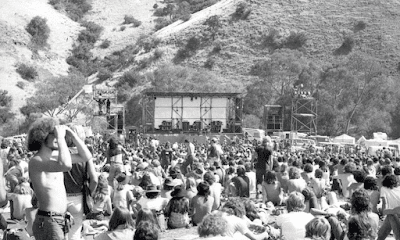
Ye Gods of Rock, it's another 50th anniversary!
Barefoot in the Grass : 50 Year Anniversary of the Sunbury Music Festival is at Hume Global Learning Centre, Sunbury, until March 27.
Tonight, there will be a panel discussion featuring festival lighting director and author Peter Evans, plus roadies, musicians and fans, and performances by Mike Rudd of Spectrum and Brenden Mason of Madder Lake.
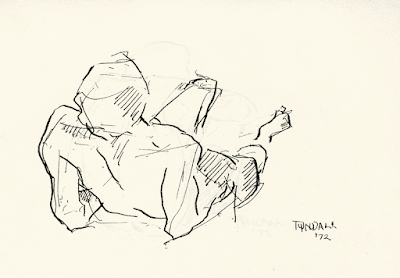
Your correspondent was there too, with a notebook a nib pen and a bottle of India Ink.
Theatre of the Anniversaries of Rock
In 1971, Mary Macqueen was one of our RMIT Architecture faculty tutors. At Crossley Gallery, I had seen her rapid impression pencil drawings of zoo animals. Hence... Theatre of the Actors of Regard
detail
A Person Looks At A Work Of Art/
someone looks at something...
LOGOS/HA HA
Unsheathe your dagger definitions. Horseness is the whatness of allhorse.
- James Joyce, Ulysses (Scylla and Charybdis)
One tries to move on, but wait there's more. This from today's inbox via the auction house Leonard Joel :

Theatre of Antiquarian Regard
detail
A Person Looks At A Work Of Art/
someone looks at something...
LOGOS/HA HA
Signed, Sealed, Delivered (I'm Yours), Stevie Wonder (1970)
A recent FIAPCE acquisition is this card by Ben; and by Philip Corner.
Initially, Ben Vautier produced the card with its printed declaration, author's stage name and date.
JE SIGNE TOUT
BEN 1960
At some stage, Fluxus co-founder Philip Corner has then signed the card with his own given name and added the red seal of his Korean pseudonym Gwan Pok, meaning 'Contemplating Waterfall.' To complete the formalities, and his cheeky Fluxus uberclaim, he has penciled it as a unique edition, 1/1.
Theatre of the Autograph(er)s of Regard
detail
A Person Looks At A Work Of Art/
someone looks at something...
LOGOS/HA HA