David Jones, artist and poet (1895-1974) begins his PREFACE TO THE ANATHEMATA :

'I have made a heap of all that I could find.' (1) So wrote Nennius, or whoever composed the introductory matter to Historia Brittonum. He speaks of an 'inward wound' which was caused by the fear that certain things dear to him 'should be like smoke dissipated'. Further, he says, 'not trusting my own learning, which is none at all, but partly from writings and monuments of the ancient inhabitants of Britain, partly from the annals of the Romans and the chronicles of the sacred fathers, Isidore, Hieronymous, Prosper, Eusebius and from the histories of the Scots and Saxons although our enemies . . . I have lispingly put together this . . . about past transactions, that [this material] might not be trodden under foot'. (2)

(1) The actual words are coacervavi omne quod inveni, and occur in Prologue 2 to the Historia.
(2) Quoted from the translation of Prologue 1. See The Works of Gildas and Nennius, J.A.Giles, London 1841.


Showing posts with label heap. Show all posts

01 January 2023

re. Covers & Standards: A Guide to the Repertoire

   
Yesterday, @livres_hon posted a photo of a page of the new journal KAFAY LARDAY. It showed various responses to the question WHAT WOULD YOU CHANGE ABOUT THE ART WORLD?.

Elizabeth Pulie wrote: “If I could, I would change the art world’s relation to, and view of, the period of conceptual art that occurred in Lippard’s ‘six years’ between 1966 and 1972. In my view, the aims of the original conceptual artists were, broadly : to practice art conceptually, in dematerialised or ephemeral forms, to escape the institutions of the object, the market, the exhibition space and even “the artist” itself, as identity. Unfortunately, these aims seem to be badly known in the current moment: this is something I would change. I would change the fact that, as predicted by Kosuth, conceptual art forms became a ‘style’ in the post-conceptual era. I would change the fact of conceptual art’s romanticisation or poeticisation in much current art, in order that its less romantic origins be made clearer.”

This morning, we listened to The Music Show on Radio National. Andrew Ford in discussion with James Gavin, responding to Ted Gioia’s new book The Jazz Standards: A Guide to the Repertoire (2nd Edition).

Thus, this first drawing of 2023, headlined standards and covers; and the second, riffing on The Way You Look Tonight, original lyrics by Dorothy Fields.

TheaTAR and the Art Repertoire  
 detail
 A Person Looks At A Work Of Art/
 someone looks at something...
  
 LOGOS/HA HA


31 December 2021

NYE : L'addition, svp.


Theatre of the Actors of Regard   
 detail
 A Person Looks At A Work Of Art/
 someone looks at something...
  
 LOGOS/HA HA


05 March 2021

re. a picture of the world


MCA Collection: Perspectives on place is open


Delve into the social and physical aspects of place. This beautiful new display from our Collection is imagined as an expanded map, weaving together a picture of the world made from stories and rituals, imprints, memories, metaphors and repurposed materials. It features over 60 works from 38 Australian artists who work across all media and showcase the rich diversity of contemporary Australian art. Curated by MCA Senior Curator, Collection, Anneke Jaspers.

Now open, free entry


Theatre of the Actors of Regard  
 detail
 A Person Looks At A Work Of Art/
 someone looks at something...
  
 LOGOS/HA HA


06 January 2021

TAR re. TAR (Teddy Watkins)


It's heap-sorting time : this from The Age (2009.11.11)


Theatre of the Actors of Regard  
 detail
 A Person Looks At A Work Of Art/
 someone looks at something...
  
 LOGOS/HA HA


22 November 2020

TARebus


bLOGOS/HA HA ðŸ’› rebus

"Largely gone from the funny pages but alive and well on the rear bumper of the car, the rebus is a visual puzzle that, in its various forms, encapsulates the history of alphabetic writing from ideograms (pictures designating concepts or things) to pictographs (pictures representing specific words or phrases) to phonograms (pictures representing specific sounds or series of sounds). Dictionaries struggle to define the term in such a way as to capture the range of shapes a rebus can take, typically focussing on its pictographic and phonogrammic attributes, forgoing mention of the ideographic. For example, the OED defines rebus as “a. An enigmatical representation of a name, word, or phrase by figures, pictures, arrangement of letters, etc., which suggest the syllables of which it is made up. b. In later use also applied to puzzles in which a punning application of each syllable of a word is given, without pictorial representation.”

... The simplest rebuses are those consisting only of letters: IOU, the (in)famous title of Marcel Duchamp’s moustached Mona Lisa “l.h.o.o.q.” (Elle a chaud au cul, literally something like ‘Her ass is hot,’ figuratively, ‘She’s horny’), and such staples of modern day texting as CUL8R or French @2m1 (à deux m un, i.e., “à demain” ‘[See you] tomorrow’)."


- Alexander Humez

Humez starts at "the funny pages", which is also how we know the rebus best. From 19th and 20th century French newspapers and trade cards, both of which we've collected. 

  original rebus artwork for Petit Illustri Amusant c.1906
(above and below by unknown artists) collection FIAPCE  
Theatre of the Actors of Regard    
  Le Chien Savant, a French trade card c.1890, 
  aka a TAR card, in which 
  - we regard...
  - a man with pipe and three cornered hat regards...
  - a clown-hatted clever dog regards... 
  a rebus of physical objects.

The young Marcel Duchamp would have grown up with such rebus word-image games as part of the day-to-day popular culture of France. Before we understood this, his LHOOQ work seemed intellectual, rarified, exotic. Now we appreciate that it follows upon the disruption-to-art news of the period (Mona Lisa stolen in 1911, recovered 1913) and is crudely street playful. 

Marcel Duchamp and Francis Picabia : Marcel Duchamp, 1919, L.H.O.O.Q. originally published in 391, n. 12, March 1920

When one knows of that popular culture common ground, of that mass daily multi-layered challenge of language and image play... after the newsprint and actuality collages, and the expanded view matrix of the various stages of Cubism,

Pablo Picasso, Siphon, Glass, Newspaper and Violin, 1912

and after Marcel Duchamp's LHOOQ, the productions of daDA and Surrealism appear obvious and inevitable. Works by children grown up, continuation rather than revolution.

 Francis Picabia, Chapeau de Paille?, 1921
 M... pour celui qui le regarde! Literally, it is addressed to
        for whoever looks at it! 
Theatre of the Actors of Regard    
        detail 
        A Person Looks At A Work Of Art/ 
        someone looks at something... 

        LOGOS/HA HA 

The view of  LHOOQ  from the distant Anglo-Antipodes is Shock of the New. Much less so where it happened. 


 Rene Magritte, L'Apparition, 1928


Above is a rebus-like portrait of Robert Rauschenberg, made in 2005 by the photographer Irving Penn. 

Today's ArtDaily Newsletter has an image of a TARist posed in regard of Robert Rauchenberg's 1955 "Rebus", now on show at MoMA. It's such a dynamic application of a title : a challenge to each person who regards this (and any other) arrangement to de-code the given, as if the world is a puzzle that can be solved and known.

Theatre of the Actors of Regard  
  Robert Rauschenberg's 'Rebus' on display during a press 
  preview of MoMA's first ever Fall Reveal at the Museum of 
  Modern Art on November 13, 2020 in New York City. 
  Cindy Ord/Getty Images/AFP

 detail
 A Person Looks At A Work Of Art/
 someone looks at something...
  
 LOGOS/HA HA


16 November 2020

text paperweights

 
A paperweight, elongated brass cube inscribed on two sides with poetry by Yosa Buson. We use it to heap and hold recent Spirax drawings such as that below.
collection : FIAPCE  
Title paperweight with copper green patina...

FIAPCE  
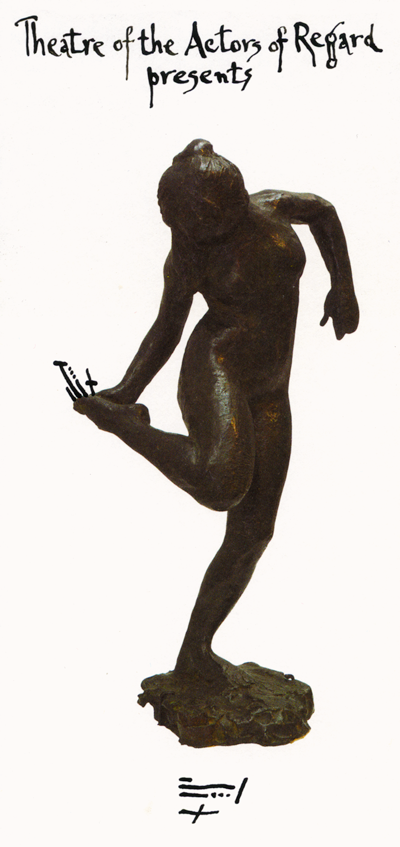
...after Edgar Degas's 'Danseuse regardant la plante de son pied droit, quatrième étude' (Dancer looks at the sole of her right foot, fourth study) c.1882–1900 [collection QAGOMA] in which a woman of bronze regards her pedestal Title reflection/growth/formation/installation.

Theatre of the Actors of Regard   
 detail
 A Person Looks At A Work Of Art/
 someone looks at something...
  
 LOGOS/HA HA


13 May 2020

paperweight


paperweight is a small solid object heavy enough (usually a glass marble), when placed on top of papers, to keep them from blowing away in a breeze or from moving under the strokes of a painting brush (as with Japanese calligraphy). 

While any object (like a stone) can serve as a paperweight, decorative paperweights of glass ] or brass or copper : see below ( are produced, either by individual artisans or factories, usually in limited editions, and are collected as works of fine art, some of which are exhibited in museums. First produced in about 1845, particularly in France, such decorative paperweights declined in popularity before undergoing a revival in the mid-twentieth century. 

- Wikipedia
 click image to enlarge  

  paperweight with Yosa Buson haiku              collection FIAPCE


FIAPCE after Degas  
 detail
 A Person Looks At A Work Of Art/
 someone looks at something...
  
 LOGOS/HA HA


26 January 2020

Australia Day/Invasion Day


 Daisy by Pond click to play


 Like, what about the empire? What about the cross?

[Intro]
It's spring and the cherry blossoms sprout
The legs are out and the bronzed chests
And fires bejeweling the southwest
Thank you, darling, for these silver gelatin echoes of me, 
    with you
Smiling like he has to for the cause
For the tribe, for the boys, for the lie

[Verse 1]
Nobody heard me crying in my sleep
Me and the men of the frontier stack the bodies in a heap
Jimmy grabs a beer and we wash our hands in the creek
Ooh, talk is cheap
Frangipanis growing back home
And they're shading the bottle-o line
Once we were dreaming of pearls
Now me and my sons all dream of iron

[Chorus]
Well, Daisy, baby, are you drivin' home?
'Cause this baby doesn't wanna walk alone
She said "Ooh" as she grabbed my tongue
Sometimes you gotta rock the cradle, baby, on your own

[Verse 2]
Ooh, is that boogoo with the big chain?
Is that Annie with the white dress?
Is that granny with the white man
With the no name and the no stress?
Like, what about the empire? What about the cross?
What about the halos? Are the angels inside with the Xbox?
Ooh, that's a dollar for any can
And on Thursdays, I'll be headin' back to see my man

[Chorus]
Well, Daisy, baby, are you drivin' home?
'Cause this baby doesn't wanna walk alone
She said "Ooh" as she grabbed my tongue
Sometimes you gotta rock the cradle, baby, on your own

[Bridge]
Damn, it's cool on the bathroom floor
Well, Daisy doesn't have a babe no more
Damn, it's cool on the bathroom floor
Daisy doesn't have a babe no more

[Outro]
Did seeing real blood remind you that I had a heart?
That was the last kiss, that was a real one
When I see you next year I'll be perfect, yeah
I'll be perfect for you, babe


 What about the halos? Are the angels inside with the Xbox?
  
 detail
 A Person Looks At A Work Of Art/
 someone looks at something...
  
 LOGOS/HA HA


06 January 2020

Making mochi in Hell


  Making mochi in Hell                                   collection : FIAPCE
The first recorded accounts of mochi being used as a part of New Year's festivities are from the Japanese Heian period. The nobles of the imperial court believed that long strands of freshly made mochi symbolized long life and well-being, while dried mochi helped strengthen one's teeth. Accounts of it can also be found in the oldest Japanese novel, The Tale of Genji.
Mochi continues to be one of the traditional foods eaten around Japanese New Year, as it is sold and consumed in abundance around this time. A special type, called kagami mochi (mirror mochi), is placed on family altars on December 28 each year. Kagami mochi is composed of two spheres of mochi stacked on top of one another, topped with an orange (daidai).    On this occasion, which was originally practiced by the samurai, the round rice cakes of kagami mochi would be broken, thus symbolizing the mirror's opening and the ending of the New Year's celebrations. (Wikipedia)


click images for info  
 detail
 A Person Looks At A Work Of Art/
 someone looks at something...
  
 LOGOS/HA HA


02 January 2020

3x TAR


1.
NGV / Theatre of the Actors of Regard  
 detail
 A Person Looks At A Work Of Art/
 someone looks at something...
  
 LOGOS/HA HA

2.
 India Art Fair / Theatre of the Actors of Regard  
 detail
 A Person Looks At A Work Of Art/
 someone looks at something...
  
 LOGOS/HA HA

3.
  
bLOGOS/HA HA / Theatre of the Actors of Regard  
 detail
 A Person Looks At A Work Of Art/
 someone looks at something...
  
 LOGOS/HA HA


26 November 2019

Performed by a storm | Observed by a cloud


The local oak
at the end of winter

Too large for a single snap


FIAPCE Fotos  
now it's the end of spring


Theatre of Animist Regard  
 detail
 A Person Looks At A Work Of Art/
 someone looks at something...
  
 LOGOS/HA HA


25 October 2019

I Spent Three Hours Staring at an Anthill


I Spent Three Hours Staring at an Anthill
by James MacDonald
JSTOR : 21 October 2019


  from Collected Papers on Ants, 1905  via Wikimedia Commons
Theatre of the Actors of Regard  
 detail
 A Person Looks At A Work Of Art/
 someone looks at something...
  
 LOGOS/HA HA


27 August 2019

amuseoLOGOS/HA HA : Dagger Definitions of TAR : Towards Amuseum(s) of Regard


Unsheathe your dagger definitions. Horseness is the whatness of allhorse.

- from James Joyce's ‘Ulysses’, an account of one person in one place on one day, 16 June 1904, published 2 February 1922.

Today, 27 August 2019, we spotlight the following HYPERALLERGIC editorial and accompanying article about re/defining The Museum. 

August 27, 2019

Letter from the Editor: 
The International Council of Museums (ICOM) released a new definition of "museum" this month, and not everyone is happy. Danish curator Jette Sandahl, who lead ICOM’s commission on the new definition, suggested, among other things:

Museums are democratising, inclusive and polyphonic spaces for critical dialogue about the pasts and the futures. Acknowledging and addressing the conflicts and challenges of the present, they hold artefacts and specimens in trust for society, safeguard diverse memories for future generations and guarantee equal rights and equal access to heritage for all people.
Museums are not for profit. They are participatory and transparent, and work in active partnership with and for diverse communities to collect, preserve, research, interpret, exhibit, and enhance understandings of the world, aiming to contribute to human dignity and social justice, global equality and planetary wellbeing.

Some immediately considered the definition too ideological, but it raises bigger questions as to whether we actually have a working definition for the institutions that are the foundation of the art world. And is defining them even possible nowadays?

I think the question of what a museum is today is just as complicated as defining what art can be. We're more likely to recognize when something isn't a museum (or art) rather than when it actually is. In an era of more private vanity museums than ever, ersatz corporate entities designed for selfie takers (Museum of Ice Cream, etc.), and the push toward expensive spectacles that require outside funding, the meaning of museum is changing.
                
The final para of the HYPERALLERGIC article :
In April, ICOM began publishing a crowdsourced list of new museum definitions from around the world. Currently, there are 269 entries on their website from countries including Spain, France, Japan, Cameroon, and Iran. The proposed definition, however, was not chosen from any of these submissions but was picked internally by Sandhal’s commission. Voting for the new definition will be held at the organization’s Extraordinary General Assembly in Kyoto, Japan, on September 7.

Unsheathe your dagger definitions. Horseness is the whatness of allhorse. Streams of tendency and eons they worship. God: noise in the street: very peripatetic. Space: what you damn well have to see. Through spaces smaller than red globules of man's blood they creepycrawl after Blake's buttocks into eternity of which this vegetable world is but a shadow. Hold to the now, the here, through which all future plunges to the past.

- from James Joyce's ‘Ulysses’

At the International Council Of Museums website
page headed Museum Definition : Creating a new museum definition – the backbone of ICOM, this is the Museum image that has ICOM provided : 
a grid of Right Angles in shades of white/ similar-sized rectangles of regard floating unsupported on walls/ NO PEOPLE or other living beings. Off to The Amuseum with that lot.


Towards Amuseum(s) of Regard  
 detail
 A Person Looks At A Work Of Art/
 someone looks at something... 
         
 LOGOS/HA HA


22 August 2019

Hotei in the guise of a street TARist


Hotei in the guise of a street performer
HAKUIN Ekaku
-1685-1768-
Hotei in the guise of a street TARist
Theatre of the Actors of Regard
after HAKUIN Ekaku
-1981-

Hotei in the guise of a street TARist
Theatre of the Actors of Regard
Bourke Street, Melbourne
photo by FIAPCE
-1981-

   detail
   A Person Looks At A Work Of Art/
   someone looks at something... 
         
   LOGOS/HA HA


10 July 2019

Title Dance|r : Struttin' With Some TARbq


 Struttin' With Some Barbeque (Lil Hardin)


 Louis Armstrong and His Hot Five (Lil Hardin, piano)

Lillian "Lil" Hardin Armstrong (née Hardin; February 3, 1898 – August 27, 1971) was a jazz pianist, composer, arranger, singer, and bandleader. She was the second wife of Louis Armstrong, with whom she collaborated on many recordings in the 1920s. Her compositions include Struttin' with Some Barbecue - Wikipedia


 Raku Ryonyu (1756-1834) Scrollin'...

 Raku Ryonyu (1756-1834) Stampin'...             


 Raku Ryonyu (1756-1834) plate with matrix ideogram

Finally, some speculative etymology. I think with affection of the Czech novelist Josef Skvorecky, who wrote in his novel THE COWARDS (or his novella THE BASS SAXOPHONE) of his difficulties with jazz-related English (he was a youthful amateur tenor player during the Second World War): encountering “Struttin’ With Some Barbecue” for the first time, he was puzzled by the word-by-word translation: could it really mean “Walking pompously with an animal carcass roasted whole”?

I have the same feelings about “Drop that sack!” Is it really an old-time racially-based joke about chicken-stealing, or did it mean, “Let’s get out of here” or “Get rid of that unattractive person”?

It adds something to the resonance of the words that DROP THAT SACK was one of the two titles that Louis recorded “anonymously” with Lil’s Hot Shots for a competing label while he was under contract to OKeh — trying to hide Louis’s conception and sound would be like pretending the great Chicago Fire wasn’t burning . . . . but I wonder if there are hidden meanings to the expression, just as we later learned that “Struttin’ with some barbecue” was a pre-PC way of saying, “Walking proudly with my beautiful girlfriend.”

- from
JAZZ LIVES


Theatre of the Animations of Regard  
 detail
 A Person Looks At A Work Of Art/
 someone looks at something... 
         
 LOGOS/HA HA