David Jones, artist and poet (1895-1974) begins his PREFACE TO THE ANATHEMATA :
'I have made a heap of all that I could find.' (1) So wrote Nennius, or whoever composed the introductory matter to Historia Brittonum. He speaks of an 'inward wound' which was caused by the fear that certain things dear to him 'should be like smoke dissipated'. Further, he says, 'not trusting my own learning, which is none at all, but partly from writings and monuments of the ancient inhabitants of Britain, partly from the annals of the Romans and the chronicles of the sacred fathers, Isidore, Hieronymous, Prosper, Eusebius and from the histories of the Scots and Saxons although our enemies . . . I have lispingly put together this . . . about past transactions, that [this material] might not be trodden under foot'. (2)
(1) The actual words are coacervavi omne quod inveni, and occur in Prologue 2 to the Historia.
(2) Quoted from the translation of Prologue 1. See The Works of Gildas and Nennius, J.A.Giles, London 1841.
Theatre of the Actors of Regard yesterday presented Three Act Regard (Part 1) in which the first regard brought forth laughter at the appearance of a Label Flower.

Theatre of the Actors of Regard
detail
A Person Looks At A Work Of Art/
someone looks at something...
LOGOS/HA HA
Today, another represenTARtion of the “Flower Sermon” offered by Guatama Buddha to his followers at Vulture Peak. There, it is said, he twirled a flower...
“At this, they all remained silent. Only the venerable Kashyapa broke into a smile. The World-Honored One said: “I have the eye treasury of the true Dharma, the marvelous mind of nirvana, the true form of no-form, the subtle gate of the Dharma. It does not depend on letters, being specially transmitted outside all teachings. Now I entrust Mahakashyapa with this.”
The scroll shown here is by Yosa Buson from the collection of Henry Weatherfield & Associates.
[Wikipedia : Yosa Buson or Yosa no Buson (与謝 蕪村, 1716 – January 17, 1784) was a Japanese poet and painter of the Edo period. Along with Matsuo Bashō and Kobayashi Issa, Buson is considered among the greatest poets of the Edo Period.)
Three Act Regard (Part 2)
Theatre of the Actors of Regard
detail
A Person Looks At A Work Of Art/
someone looks at something...
LOGOS/HA HA
Before enlightenment, chop wood and carry water; after enlightenment, chop wood and carry water.
— Zen proverb


Nagasawa Rosetsu (1754-1799) collection FIAPCE
One, two, buckle my shoe
Three, four, shut the door
Five, six, pick up sticks
Seven, eight, lay them straight
Nine, ten, begin again
— Children's verse (Traditional)

Theatre of the Actors of Regard
detail
A Person Looks At A Work Of Art/
someone looks at something...
LOGOS/HA HA
The work is not signed by the artist, but it bears numerous inscriptions, seals and signatures from its subsequent owners — including the seals of the Southern Tang emperor Li Yu, the Song theorist Mi Fu, and the Qianlong Emperor — show that it passed through the hands of many collectors over the following 1,200 years.
The original drawing, some 12 inches (30 cm) square, was later mounted on a 20 feet (6.1 m) long handscroll to provide sufficient space for the seals and inscriptions.The original drawing...

Theatre of the Actors of Regard
detail
A Person Looks At A Work Of Art/
someone looks at something...
LOGOS/HA HA
there is no outside-text
- Jacques Derrida, De la grammatologie (1967)
Of Grammatology (transl G. Spivak, 1976) 
FIAPCE (-1977-)

Theatre of the Actors of Regard
detail
A Person Looks At A Work Of Art/
someone looks at something...
LOGOS/HA HA
Philip Brophy in this weekend's MeMO review :
Everyone simply loved it. State politicians stood in front of it (like every moron in Melbourne) to have their photo taken. The NGV website has a short promo discussing its curatorial purchase and placement. But do you think I could find anyone anywhere to critically engage with this work, short of reprising the NGV’s sound-bytes or Anadol’s own assertions? Am I second-guessing that most MeMO readers saw it, hated it and can’t bring themselves to even remember it? Maybe therein lies the core of the problem: how screen culture’s increasing leakage of totemic and monumental art commissions constitutes a critical drowning-out of discursive engagement.
Theatre of the Actors of Regard
NGV Triennial 2020 installation view of Refik Anadol (designer); Refik Anadol Studio, Los Angeles (design studio) Quantum memories 2020. Commissioned by the National Gallery of Victoria, Melbourne. Proposed acquisition with funds donated by Loti & Victor Smorgon Fund and Barry Janes and Paul Cross, 2020 © Refik Anadol.
Photo: Tom Ross
As above, so below :
TARist
projection-space
words
Yosa Buson (1716-1784) ink paper scroll digital reproduction regard
Theatre of the Actors of Regard
detail
A Person Looks At A Work Of Art/
someone looks at something...
LOGOS/HA HA
GET SHORTY
] A Re-make (
Two unlikely literary
detectives receive
bloodied haiku
manuscript:
GET HAIKU
HAND SPACE
Advertisement as clue :
"Get Haiku" Getto Aoki Haiku width box of 1 width
Masaoka Shiki, Osaka Senbajin Kansai Haiku Kansai Haiku Matsuse Aoi Yosa Buson
collection: FIAPCE
above: haiku for the Bridge of Dreams incident...
Theatre of the Actors of Regard
detail
A Person Looks At A Work Of Art/
someone looks at something...
LOGOS/HA HA

collection FIAPCE

A Person Looks At A Work Of Art/
someone looks at something...
LOGOS/HA HA
Further to the earlier pangrams, this endless round we learned when young.

This old man, he played one,
He played knick-knack on my drum;
With a knick-knack paddywhack,
Give the dog a bone,
This old man came rolling home.

Yosa Buson (1716-1784)
This old man, he played two,
He played knick-knack on my shoe;
With a knick-knack paddywhack,
Give the dog a bone,
This old man came rolling home.
This old man, he played three,
He played knick-knack on my knee;
With a knick-knack paddywhack,
Give the dog a bone,
This old man came rolling home.
This old man, he played four,
He played knick-knack on my door;
With a knick-knack paddywhack,
Give the dog a bone,
This old man came rolling home.
This old man, he played five,
He played knick-knack on my hive;
With a knick-knack paddywhack,
Give the dog a bone,
This old man came rolling home.
This old man, he played six,
He played knick-knack with my sticks;
With a knick-knack paddywhack,
Give the dog a bone,
This old man came rolling home.
This old man, he played seven,
He played knick-knack up in heaven;
With a knick-knack paddywhack,
Give the dog a bone,
This old man came rolling home.
This old man, he played eight,
He played knick-knack on my gate;
Give the dog a bone,
This old man came rolling home.
This old man, he played nine,
He played knick-knack on my spine;
With a knick-knack paddywhack,
Give the dog a bone,
This old man came rolling home.
This old man, he played ten,
He played knick-knack once again;
With a knick-knack paddywhack,
Give the dog a bone,
This old man came rolling home.

collection FIAPCE
detail
A Person Looks At A Work Of Art/
someone looks at something...
LOGOS/HA HA

Theatre of the Actors of Regard
detail
A Person Looks At A Work Of Art/
someone looks at something...
LOGOS/HA HA
Regarding
coronavirus
Regarding
toilet paper scrolls
[stock photo ideal view]

Theatre of the Actors of Regard
Regarding
toilet paper scrolls
[coronavirus desperation view]

Theatre of the Actors of Regard
In the land of the blind
the one-roll man is king.
I AM THE LOO KING

Theoria : the act of looking, the act of regard
TAR : Theatre of the Actors of Regard
Theoria Rex (Corona Rex) : The Loo King
'I am the Loo King' : Anthem of the Loo King. Sung at the Court of TAR to the melody of Russell Morris's Real Thing (1969).
Come and see the loo king, come and see the loo king, come and see
Come and see the loo king, come and see the loo king, come and see
There's a meaning there, but the meaning there doesn't really mean a thing
Come and see the loo king, come and see the loo king, come and see
I am the loo king !
Oo mama mow-mow
Oo mama mow-mow
Oo mama mow-mow
Oo mama mow-mow

Theatre by Appointment of the RegisTAR
Oo mama mow-mow
Oo mama mow-mow
Oo mama mow-mow
Oo mama mow-mow

Theatre of the AcquisiTAR of the Roll
detail
A Person Looks At A Work Of Art/
someone looks at something...
LOGOS/HA HA
TAR series
Animal, Vegetable, Mineral?

This week's panel
Sir Mortimer Wheeler, Jacquetta Hawkes,
Julian Huxley
Sponsored by
CRAVEN A
Theatre of the Actors of Regard
AdjudicaTAR with ideoProjection-Space
Glyn Daniel

Theatre of the Actors of Regard
This week's ***** for deTARmination :
Regard-at-large of image of 'Rock and Orchid' scroll by Ike Taiga (1723-1776)
Yes, ladies and gentlermen, girls and boys, this week it is in fact all three catagories : Animal, vegetable and mineral.


Theatre of the Actors of Regard
detail
A Person Looks At A Work Of Art/
someone looks at something...
LOGOS/HA HA
Part 2 of the exhibition Never the same river is at Anna Schwartz Gallery until 21 December 2019.
 Theatre of the Actors of Regard John Nixon
wall installation by Denton Corker Marshall
Never the same river is a thought that flows to us from the Western side of the mountain, from Greece, Heraclitus of Ephasus.
Heraclitus of Ephesus (Ἡράκλειτος, Herakleitos; c. 535 BC – 475 BC) was a Greek philosopher, known for his doctrine of change being central to the universe, and for establishing the term Logos (λόγος) in Western philosophy as meaning both the source and fundamental order of the Cosmos. - Wikipedia
Heraclitus believed the world was somehow in accordance with Logos (literally, "word", "reason", or "account"). He also believed the world was ultimately made of fire. He was committed to a unity of opposites and harmony in the world. He was most famous for his insistence on ever-present change, or flux or becoming, as the characteristic feature of the world, as stated in the famous saying No man ever steps in the same river twice as well as Panta rhei, everything flows. This aspect of his philosophy is contrasted with that of Parmenides, who believed in being, and that nothing changes. Both had an influence on Plato and thus on all of Western philosophy. - Wikipedia

FIAPCE (-2019-)
Flowing down the Eastern slopes, from Lao Tzu through to the present Hong Kong anti-Beijing resistance movement, Be as water. From the
Tao Te Ching :
Nothing is weaker than water,
But when it attacks something hard
Or resistant, then nothing withstands it,
And nothing will alter its way.

Let the rivers flow ] to the see ( a Daylesford Community Banners Project : carried in the 1982-83 Daylesford New Year's Eve Parade in support of the Franklin Blockade and against the proposed damming of Tasmania's wild Franklin River.


from Anti-Oedipus by Deleuze and Guattari, written in pencil
on one of the canvas panels :
Desiring-machines are binary machines, obeying a binary law or set
of rules governing associations: one machine is always coupled with
another. The productive synthesis, the production of production, is
inherently connective in nature: "and . . ." "and then . . ." This is
because there is always a flow-producing machine, and another machine
connected to it that interrupts or draws off part of this flow (the
breast—the mouth). And because the first machine is in turn connected
to another whose flow it interrupts or partially drains off, the binary
series is linear in every direction. Desire constantly couples continuous
flows and partial objects that are by nature fragmentary and fragmented.
Desire causes the current to flow, itself flows in turn, and breaks the
flows. "I love everything that flows, even the menstrual flow that carries
away the seed unfecund."* Amniotic fluid spilling out of the sac and
kidney stones; flowing hair; a flow of spittle, a flow of sperm, shit, urine that are produced by partial objects and constantly cut off by other partial objects, which in turn produce other flows, interrupted by other
partial objects. Every "object" presupposes the continuity of a flow;
every flow, the fragmentation of the object. Doubtless each
organ-machine interprets the entire world from the perspective of its own
flux, from the point of view of the energy that flows from it: the eye
interprets everything—speaking, understanding, shitting, fucking—in
terms of seeing. But a connection with another machine is always
established, along a transverse path, so that one machine interrupts the
current of the other or "sees" its own current interrupted.
*Henry Miller, Tropic of Cancer, Ch. 13. See in this same chapter the celebration of desire-as-fully-expressed in the phrase: ". . . and my guts spilled out in a grand schizophrenic rush, an evacuation that leaves me face to face with the Absolute."
Hence the coupling that takes place within the partial object-flow
connective synthesis also has another form: product/producing. Producing is always something "grafted onto" the product; and for that reason
desiring-production is production of production, just as every machine
is a machine connected to another machine. We cannot accept the
idealist category of "expression" as a satisfactory or sufficient explanation of this phenomenon. We cannot, we must not attempt to describe
the schizophrenic object without relating it to the process of production.
 Richard Lindner, 'Boy with Machine' (1954)
... The satisfaction the
handyman experiences when he plugs something into an electric socket
or diverts a stream of water can scarcely be explained in terms of
"playing mommy and daddy," or by the pleasure of violating a taboo.
The rule of continually producing production, of grafting producing onto
the product, is a characteristic of desiring-machines or of primary
production: the production of production. A painting by Richard
Lindner, "Boy with Machine," shows a huge, pudgy, bloated boy
working one of his little desiring-machines, after having hooked it up to
a vast technical social machine—which, as we shall see, is what even the
very young child does.
Richard Lindner, 'Boy with Machine' (1954)
... The satisfaction the
handyman experiences when he plugs something into an electric socket
or diverts a stream of water can scarcely be explained in terms of
"playing mommy and daddy," or by the pleasure of violating a taboo.
The rule of continually producing production, of grafting producing onto
the product, is a characteristic of desiring-machines or of primary
production: the production of production. A painting by Richard
Lindner, "Boy with Machine," shows a huge, pudgy, bloated boy
working one of his little desiring-machines, after having hooked it up to
a vast technical social machine—which, as we shall see, is what even the
very young child does.

Theatre of the Actors of Regard
before and after 'Boy with machine' (Lindner)
detail
A Person Looks At A Work Of Art/
someone looks at something...
LOGOS/HA HA

Theatre of the Actors of Regard
Untitled
Umbo (Otto Umbehr). 1946

Theatre of the Actors of Regard
Smoke Dragon Temple, Japan
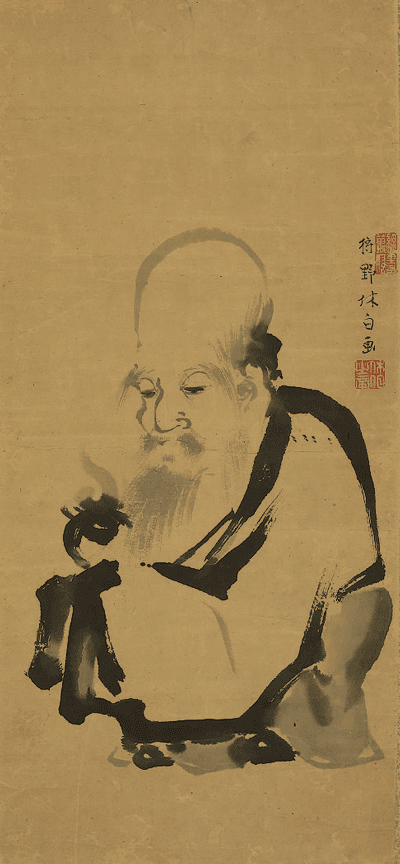
Theatre of the Actors of Regard
Fukurokuju holding hōju (flaming pearl of wisdom) in regard
Kano Kyuhaku (1621-1688)
collection FIAPCE

Theatre of the Actors of Regard
A Person Looks At A Work Of Art/
someone looks at something...
Bumble : "Nathan Lyon is coming back
for another spell."
Paine : "Come on, Gary."
The fourth test, Old Trafford:
Day five, the last hour...
Australia retains the Ashes!

Inoue Shiro (1742-1812) collection FIAPCE
A Person Looks At A Work Of Art/
someone looks at something...


