David Jones, artist and poet (1895-1974) begins his PREFACE TO THE ANATHEMATA :
'I have made a heap of all that I could find.' (1) So wrote Nennius, or whoever composed the introductory matter to Historia Brittonum. He speaks of an 'inward wound' which was caused by the fear that certain things dear to him 'should be like smoke dissipated'. Further, he says, 'not trusting my own learning, which is none at all, but partly from writings and monuments of the ancient inhabitants of Britain, partly from the annals of the Romans and the chronicles of the sacred fathers, Isidore, Hieronymous, Prosper, Eusebius and from the histories of the Scots and Saxons although our enemies . . . I have lispingly put together this . . . about past transactions, that [this material] might not be trodden under foot'. (2)
(1) The actual words are coacervavi omne quod inveni, and occur in Prologue 2 to the Historia.
(2) Quoted from the translation of Prologue 1. See The Works of Gildas and Nennius, J.A.Giles, London 1841.
TARist observed
Professor Bois

"Throw your hands in the air like you met a meta-care." Yve-Alain Bois
TARist the mimic
tickled the void
and said
quote : everything
Theatre of the Actors of Regard
detail
A Person Looks At A Work Of Art/
someone looks at something...
LOGOS/HA HA


Theatre of the Actors of Regard
detail
A Person Looks At A Work Of Art/
someone looks at something...
LOGOS/HA HA


Theatre of the Actors of Regard
detail
A Person Looks At A Work Of Art/
someone looks at something...
LOGOS/HA HA
Hyakka Ryōran (百花繚乱) is a Japanese phrase meaning 'Countless flowers blooming in profusion'.
The scroll below, 'Hyakka Fukunozu' (百福之図), we take to be of the same genre. Here, the flowers are countless Otafuku (the goddess of laughter) engaged in their various wisdom activities. (One is washing her hair.)
In the top right corner is a meta-scroll regarded by two Otafuku. It depicts a 'hoju' aka 'the flaming pearl of wisdom'.

collection : FIAPCE
(above) Otafuku studying the Title
Theatre of the Actors of Regard
A Person Looks At A Work Of Art/
someone looks at something...
thought | script | TAR
Theatre of the Actors of Regard
detail
A Person Looks At A Work Of Art/
someone looks at something...
LOGOS/HA HA
It's National NAIDOC Week : bLOGOS/HA HA comes to you from Dja Dja Wurrung country, central Queen Victoria Land, not far by car from Lord Melbourne Town.
Star Theatre of the Actors of Regard (yesterday)
Regarding the STARsign on the mask of a tribal leader :In Australian Aboriginal astronomy, Crux and the Coalsack mark the head of the 'Emu in the Sky' (which is seen in the dark spaces rather than in the patterns of stars) in several Aboriginal cultures,[40] while Crux itself is said to be a possum sitting in a tree (Boorong people of the Wimmera region of northwestern Victoria), a representation of the sky deity Mirrabooka (Quandamooka people of Stradbroke Island), a stingray (Yolngu people of Arnhem Land), or an eagle (Kaurna people of the Adelaide Plains).[41] Two Pacific constellations also included Gamma Centauri. Torres Strait Islanders in modern-day Australia saw Gamma Centauri as the handle and the four stars as the trident of Tagai's Fishing Spear. The Aranda people of central Australia saw the four Cross stars as the talon of an eagle and Gamma Centauri as its leg.Various peoples in the East Indies and Brazil viewed the four main stars as the body of a ray. In both Indonesia and Malaysia, it is known as Bintang Pari and Buruj Pari,[43] respectively ("ray stars"). This aquatic theme is also shared by an archaic name of the constellation in Vietnam, where it was once known as sao Cá Liệt (the ponyfish star).[44]
The Javanese people of Indonesia called this constellation Gubug pèncèng ("raking hut") or lumbung ("the granary"), because the shape of the constellation was like that of a raking hut.[45]
The Southern Cross (α, β, γ and δ Crucis) together with μ Crucis is one of the asterisms used by Bugis sailors for navigation, called bintoéng bola képpang, meaning "incomplete house star"[46]
The Māori name for the Southern Cross is Māhutonga and it is thought of as the anchor (Te Punga) of Tama-rereti's waka (the Milky Way), while the Pointers are its rope.[47] In Tonga it is known as Toloa ("duck"); it is depicted as a duck flying south, with one of his wings (δ Crucis) wounded because Ongo tangata ("two men", α and β Centauri) threw a stone at it. The Coalsack is known as Humu (the "triggerfish"), because of its shape. In Samoa the constellation is called Sumu ("triggerfish") because of its rhomboid shape, while α and β Centauri are called Luatagata (Two Men), just as they are in Tonga. The peoples of the Solomon Islands saw several figures in the Southern Cross. These included a knee protector and a net used to catch Palolo worms. Neighboring peoples in the Marshall Islands saw these stars as a fish. Peninsular Malays also see the likeness of a fish in the Crux, particularly the Scomberomorus or its local name Tohok.[43]
and so on (see : Theatre of Infinite Projections)
- Wikipedia
Raphael, Trouble At Mill : "IN THIS SIGN CONQUER" (God)
The Southern Cross has been a part of Australia’s Indigenous cosmology for millennia.
Unseen in the Northern Hemisphere since the beginning of the Christian era, the Southern Cross constellation was rediscovered by European voyagers in the late 15th century and taken as a sign of divine blessing for their conquests.
Named 'Crux Australis' and identified with the southern continents, it is considered Australia’s oldest symbol.
Since 1823 the Southern Cross has appeared on the flags intended to represent Australia. Combined with the Union Jack on the National Colonial flag and the blue and red ensigns of 1903, it served as an emblem of loyalty and affiliation with the British crown.
Appearing alone on the Eureka flag of 1854, it represented a more ‘independent’ spirit.
To each their own. Stars of TAR recently re-envisioned and re-named this five plot points asterism 'The Net'. (see also : Indra's Net of which TAR regards The Net as just one flickering point.)
Star Theatre of the Actors of Regard
HAND SPACE : five plot point constellation
[to Astra Seneca and beyond)
ASTRA is the accusative plural form of the Latin word astrum, 'star' (from Greek astron 'a star', derived from PIE root ster-). 'Ad astra' is a Latin phrase meaning 'to the stars'.
SENECA the Younger, wrote in Hercules: "Non est ad astra mollis e terris via" ('There is no easy way from the earth to the stars').
= ASTRA SENECA
Prime Minister Scott Morrison looks at a vial of AstraZeneca vaccine
HAND SPACE | Star Theatre of the Actors of Regard
detail
A Person Looks At A Work Of Art/
someone looks at something...
LOGOS/HA HA
Sometimes, seeing one thing...  Hilma af Klint
Group X, Altarpiece, no. 1
1915
oil and metal leaf on canvas
237.5 x 179.5 cm

FIAPCE -1992- Theatre of the Actors of Regard
detail
A Person Looks At A Work Of Art/
someone looks at something...
LOGOS/HA HA
[after The Triumph of Christianity over Paganism
by Tommaso Laureti Siciliano, 1585)
Santilla Chingaipe : Are ‘race’ and ‘caste’ synonymous, or are they mutually exclusive?
Isabel Wilkerson : In the ways that I am hoping and urging us to see past what we are accustomed to seeing and to recognise that we can learn so much when we look from the perspective of the infrastructure of the society, to recognise that a society, or a hierarchy, a caste system, can use any number of metrics in determining the arbitrary nature of division. These things are arbitrary; this is not real. I mean, this is like, you choose a particular characteristic and you need to get the work done and you use this characteristic as a thing that will assign an entire group to the bottom and lift up another group to the very top. And so, the idea of race, one way of looking at it, is that caste is the bones of the infrastructure of a society, it is more of a universal impulse to rank and divide and to keep people in a fixed place to have a hierarchy to have a ladder of value assigned to people in a particular society, and you can use any number of metrics in doing that. It just so happened that this was the metric that was convenient for European colonists, and I’m speaking about the United States and the English colonists in particular. Of course, this also created, between colonisation and enslavement, created essentially a global caste system that was based upon the standards that were set by those who had the power to colonise and to enslave. And that’s what we all have inherited as a species.
'Caste' (extract)
Recorded 1 May 2021 Sydney Writers Festival
Skylight guillotine at Sinclair Gallery, Castlemaine Art Museum
detail
A Person Looks At A Work Of Art/
someone looks at something...
LOGOS/HA HA
or
Pointing Portrait at the Peak
collection FIAPCE
Sacred Mountain (Mt. Heap)as
Sacred Image (Signed by Sengai) as
Sacred Regard (TAR)

Theatre of the Actors of Regard
detail
A Person Looks At A Work Of Art/
someone looks at something...
LOGOS/HA HA
"Show me your original face before your mother and father were born."
You cannot describe it, you cannot picture it,You cannot admire it, you cannot sense it.
It is your true self, it has nowhere to hide.
When the world is destroyed, it will not be
destroyed.
- Mumon, The Gateless Gate #23 (1288)
Do Not Think Good, Do Not Think Not-Good
. . . .
2021 is the 100th year of the Art Gallery of New South Wales' Archibald Prize for portraiture.
From the 6000 portraits exhibited as finalists over the past century, cold case detectives at AGNSW have identified 100 of these for a Portrait of the Nation two year Tour of Shame : Archie 100
AAA : Art Archive Australia
"There are eight million stories in the naked city. This is one of them."
- NAKED CITY (1958-1963)
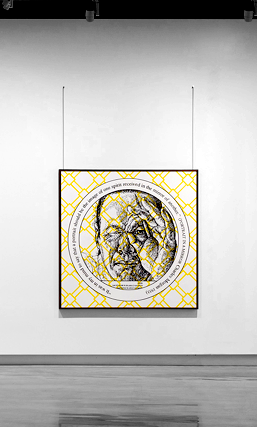
Signed Confession :
"It was in my mind to say that a portrait should be the image of one spirit received in the mirror of another"
- PORTRAIT IN A MIRROR, Charles Morgan (1933)
Suspended Sentence : TAR co-portrait (-1991-)
Known Associates :
2018.03 Michael Buxton and Charles Justin
collection : Buxton Contemporary, Melbourne
Last seen :
Art Gallery of New South Wales
5 June – 26 September 2021
Geelong Gallery
6 November 2021 – 20 February 2022
Cairns Art Gallery
18 March – 12 June 2022
Art Gallery of South Australia
9 July – 2 October 2022
Queen Victoria Museum and Art Gallery, Launceston
24 October 2022 – 8 January 2023
Bathurst Regional Art Gallery
26 January – 26 March 2023
Museum and Art Gallery of the Northern Territory
15 April – 25 June 2023
Home of the Arts, Gold Coast
15 July – 2 October 2023
National Portrait Gallery, Canberra
21 October 2023 – 28 January 2024
Theatre of the Actors of Regard
detail
A Person Looks At A Work Of Art/
someone looks at something...
LOGOS/HA HA