David Jones, artist and poet (1895-1974) begins his PREFACE TO THE ANATHEMATA :
'I have made a heap of all that I could find.' (1) So wrote Nennius, or whoever composed the introductory matter to Historia Brittonum. He speaks of an 'inward wound' which was caused by the fear that certain things dear to him 'should be like smoke dissipated'. Further, he says, 'not trusting my own learning, which is none at all, but partly from writings and monuments of the ancient inhabitants of Britain, partly from the annals of the Romans and the chronicles of the sacred fathers, Isidore, Hieronymous, Prosper, Eusebius and from the histories of the Scots and Saxons although our enemies . . . I have lispingly put together this . . . about past transactions, that [this material] might not be trodden under foot'. (2)
(1) The actual words are coacervavi omne quod inveni, and occur in Prologue 2 to the Historia.
(2) Quoted from the translation of Prologue 1. See The Works of Gildas and Nennius, J.A.Giles, London 1841.
 Auguste Rodin versus
Tony Albert
Benjamin Armstrong
Frank Auerbach
Australian Dance Theatre
Francis Bacon
Phyllida Barlow
Huma Bhabha
Polly Borland
Louise Bourgeois
Pat Brassington
Cecily Brown
Janet Burchill
Eugène Carrière
Thea Costantino
Olive Cotton
Bridget Currie
Tacita Dean
Max Dupain
Anne Ferran
Urs Fischer
Simryn Gill
Felix Gonzalez-Torres
Antony Gormley
Brent Harris
Bill Henson
Barbara Hepworth
Thomas Houseago
Sui Jianguo
William Kentridge
Bharti Kher
Emily Kame Kngwarreye
Rosemary Laing
Lindy Lee
Ben Leslie
Sherrie Levine
Sarah Lucas
Guy Maestri
Mark Manders
Ricky Maynard
Rob McLeish
Henry Moore
Chris Ofili
Dennis Oppenheim
Mike Parr
João Penalva
Paul Pfeiffer
Seth Price
Sara Rahbar
Elvis Richardson
Julia Robinson
Ugo Rondinone
David Rosetzky
Alison Saar
Yhonnie Scarce
Tim Silver
Kiki Smith
Fiona Tan
Wolfgang Tillmans
Francis Upritchard
Bill Viola
Danh Vō
Kara Walker
Gillian Wearing
Kehinde Wiley
Xu Zhen
Auguste Rodin versus
Tony Albert
Benjamin Armstrong
Frank Auerbach
Australian Dance Theatre
Francis Bacon
Phyllida Barlow
Huma Bhabha
Polly Borland
Louise Bourgeois
Pat Brassington
Cecily Brown
Janet Burchill
Eugène Carrière
Thea Costantino
Olive Cotton
Bridget Currie
Tacita Dean
Max Dupain
Anne Ferran
Urs Fischer
Simryn Gill
Felix Gonzalez-Torres
Antony Gormley
Brent Harris
Bill Henson
Barbara Hepworth
Thomas Houseago
Sui Jianguo
William Kentridge
Bharti Kher
Emily Kame Kngwarreye
Rosemary Laing
Lindy Lee
Ben Leslie
Sherrie Levine
Sarah Lucas
Guy Maestri
Mark Manders
Ricky Maynard
Rob McLeish
Henry Moore
Chris Ofili
Dennis Oppenheim
Mike Parr
João Penalva
Paul Pfeiffer
Seth Price
Sara Rahbar
Elvis Richardson
Julia Robinson
Ugo Rondinone
David Rosetzky
Alison Saar
Yhonnie Scarce
Tim Silver
Kiki Smith
Fiona Tan
Wolfgang Tillmans
Francis Upritchard
Bill Viola
Danh Vō
Kara Walker
Gillian Wearing
Kehinde Wiley
Xu Zhen
+ + + +

FIAPCE (1974)
detail
A Person Looks At A Work Of Art/
someone looks at something...
LOGOS/HA HA


detail
A Person Looks At A Work Of Art/
someone looks at something...
LOGOS/HA HA
email to FIAPCE from NGV
BILL HENSON
10 MAR – 27 AUG 17
NGV INTERNATIONAL
In every form of art, you really want the experience of the images to transcend the medium, for the medium to disappear into the greater experience of viewing the work. So that you forget you are looking at a painting, or a photograph.
- Bill Henson
response from FIAPCE
 Photograph by John B. Turner : Dr Isobel Crombie, Snr Curator
of Photography, National Gallery of Victoria, Melbourne,
discussed a photograph by Bill Henson at the Auckland Art
Gallery's Art Lounge, Lorne Street, Auckland CBD,
14 June 2009.jpg
Photograph by John B. Turner : Dr Isobel Crombie, Snr Curator
of Photography, National Gallery of Victoria, Melbourne,
discussed a photograph by Bill Henson at the Auckland Art
Gallery's Art Lounge, Lorne Street, Auckland CBD,
14 June 2009.jpg
detail
A Person Looks At A Work Of Art/
someone looks at something...
LOGOS/HA HA
Researching Sister Corita Kent's artwork recently, we found this image & quote from the Vatican Two instigator and reformer Pope John 23 (1958-1963).
A skew second to the open spirit of that statement, nonetheless noted, was the pun-ish play between guard and garden.
From there to thoughts of the observer ("I like to watch") and projection-space 'Chauncey Gardiner' in Being There.
Yesterday, reading the following description of the National Gallery of Victoria by a former NGV guard rang that same odd sense of right and wrong delight.
"I can't even walk into the NGV anymore … it's lost its reputation for me and I consider it now to be like an illegal sweatshop."
The ABC report included this image of a blur-headed guard, with the same caption as below.


detail
A Person Looks At A Work Of Art/
someone looks at something...
LOGOS/HA HA
The Field
figure and figure
someone looks at something...

Museum of Modern Art, NY
USA : In Andrew Wyeth's 1948 Christina’s World (above) a woman lying in a field looks up at a large house set against a dull sky.

Ballarat Art Gallery
Australia : In Jeffrey Smart's 1965 The Listeners (above) a man lying in a field looks up at a big red scanning device set against dark threatening cloud.
Jindalee is an aboriginal word for a place [the] eye cannot see, or somewhere beyond where the eye can see, like over the horizon.
The original project to develop an over-the-horizon radar in Australia was called Jindalee and the operational outcome of that project called JORN 3 continues the use of the iconic name Jindalee.
“To me, the JORN system is one of Australia's quietest achievers. It is an astounding system, the most capable radar network in the world, all Australian designed and built, and should be acknowledged as one of Australia's finest defence technology achievements”.
- The Institution of Engineers Australia - Nomination of Jindalee for Heritage Recognition

Tim O'Brien
USA : In Tim O'Brien's recent 2017 reworking of Christina's World (above), Counselor to President Trump, Kellyanne Conway (she of "alternative facts") is alternated from the White House ...
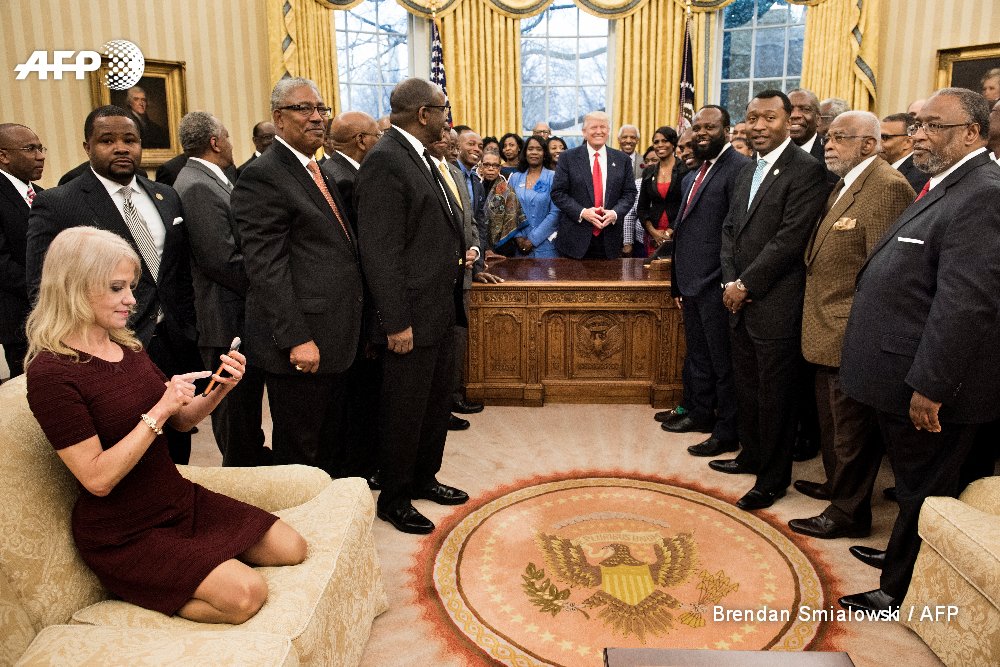
photo : Brendan Smialowski/AFP
... along with the White House, into 1948 Wyeth World/Christina World where, still oblivious of her surroundings, she continues to trans-act with her device.

Theatre of the Actors of Regard
Australia : Theatre of the Actors of Regard, 1952. Tableau vivant by Bendigo performance prodigy Barry Block & The Blockbusters.
As these image-events gather, something is starting to make sense to someone...
USA : wtf ! That big red scanner on the hill...?!

TAR : click image to enlarge
detail
A Person Looks At A Work Of Art/
someone looks at something...
LOGOS/HA HA
Senator Sessions swearing. Lying.
LOGOS/HA HA : Speaking unTruth into Being

Theatre of the Advocates of Rectitude
Such a strange shape that swearer makes...
Here's an explanation from NWSidebar - The Voices of Washington's Lawyers and Legal Community :
Why Do We Raise Our Right Hands When Testifying Before the Court?
“Please raise your right hand to take the oath” is a phrase that has become commonplace in the modern courtroom and is required of all witnesses before they take the stand to offer testimony at trial. However, many attorneys may not be aware of the purpose or history of the practice of “raising your right hand” when swearing to tell the truth before the court.
Most have located the origin of the practice in the central criminal court of 17th century London. Judges in London’s courts, from the late 17th century to the early 20th century, could choose from a wide range of punishments, which varied in severity from a full pardon to the death sentence. However, judges lacked a sophisticated means to maintain a criminal defendant’s records to help them assess which penalty was most appropriate to the defendant’s circumstances. As a result, judges sometimes chose to punish criminals with a branding.
 Jonathan Walker's branded hand, SS for Slave Stealer, 1845
Branding, which literally meant the application of a branding iron to the convicted defendant’s body, was generally imposed upon convicts who received leniency from the court. For example, convicts who successfully pleaded “benefit of the clergy” — a practice which would spare a defendant affiliated with the Church from a death-penalty punishment — “were branded on the thumb (with a “T” for theft, “F” for felon, or “M” for murder), so that they would be unable to receive this benefit more than once.” (The Proceedings of Old Bailey, Punishments at the Old Baily : http://www.oldbaileyonline.org/static/Punishment.jsp)
Similar brands were issued to convicts who were found guilty of manslaughter instead of murder.
FIAPCE ideo brand, c.1976/77
Should the convict appear before the Court again, they would be required to raise their right hand, which would allow the Court to assess whether they had committed any previous crimes or received leniency in the past. This indelible “criminal record” was thus a sort of pre-cursor to the “character evidence” of today.
Like today’s courts, however, London’s 17th century courts also saw the value in limiting access to certain forms of character evidence. For example, for a short period of time, thieves were branded on the cheek. However, the practice proved far too prejudicial, as convicts often were left unable to find work. The practice of branding on the hand — and, therefore, the practice of raising the right hand in court — continued.
Theatre of the Actors of Regard
Although the practice has clearly outgrown its initial purpose, it still takes place in courtrooms across the country and serves as an interesting reminder of the history and tradition that has paved the way for the modern American judiciary.
 Jeff Sessions being sworn in before his confirmation hearing in January. Photo Stephen Crowley/The New York Times
Theatre of the Angle(s) Right
detail
A Person Looks At A Work Of Art/
someone looks at something...
LOGOS/HA HA


detail
A Person Looks At A Work Of Art/
someone looks at something...
LOGOS/HA HA
Thanks to the sponges—raw living matter—I was going to be able to make portraits of the observers of my monochromes, who . . . after having voyaged in the blue of my pictures, return totally impregnated in sensibility, as are the sponges.
Yves Klein, “Remarques sur quelques oeuvres exposées chez Colette ‘Allendy’,” 1958, Klein archive

Yves Klein with Blue Sponge (1959)
HAND SPACE
blue TAR
Is your heart still there
If they sell us out like sponge cake
Do you really care
Hey True Blue
'True Blue' is an Australian folk song written and performed in 1981 by singer-songwriter John Williamson. The lyrical content utilises Australian slang heavily, with the title meaning authentically Australian. (Wikipedia)

Artist
Bruce Nauman (1941-)
Title
Self Portrait as a Fountain
Portfolio/Series
Eleven Color Photographs
Date
1966-67, printed 1970
Medium
Chromogenic print
Dimensions
Sheet (sight): 20 1/16 × 23 15/16 in. (51 × 60.8 cm) Image (sight): 19 1/2 × 23 1/4 in. (49.5 × 59.1 cm)
Edition information
7/8
Credit line
Whitney Museum of American Art, New York; Purchase
Accession number
70.50.9
Rights and Reproductions Information
© artist or artist’s estate
Object Label
Self-Portrait as a Fountain is one of Bruce Nauman’s Photographic Suite of eleven photographs based on puns. The portfolio reveals Bruce Nauman’s interest in the functions of language, as he humorously depicts literal interpretations of common phrases. In Self-Portrait as a Fountain, Nauman questions the traditional role of the artist. He depicts himself shirtless, with raised arms and open palms, spewing an arc of water out of his pursed lips, in imitation of the nude statues customarily found in decorative fountains. Thus the artist and the work of art become one and the same. During the period in which he made this work, Nauman used the statement “The true artist is an amazing luminous fountain” in a number of text-based works. This playful illustration of the statement satirizes the cliché of the artist as a prolific genius who spews forth a steady stream of masterpieces. Self-Portrait as a Fountain also pays homage to Marcel Duchamp‘s notorious Fountain (1917)—a readymade porcelain urinal that Duchamp provocatively exhibited as a sculpture. Like Fountain, Nauman’s Self-Portrait as a Fountain subverts conventional definitions of what constitutes a work of art.
Atlan Theatre of the Actors of Regard
after The Persecution and Assassination of
Jean-Paul Marat as Performed by the Inmates of the Asylum of Charenton Under the Direction of the Marquis de Sade aka Marat/Sade
Act 1 : enter the 'crazy' post-Duchamp early-Nauman reconstrucTAR - pauses to regard HAND SPACE exhibition - soundtrack of The Mamas &
The Papas "People Like Us" :
Oh, what a dump,
Now it's a palace
Where a Dixie cup becomes a chalice
For people like us,
So much in, so much in love,
In love
Act 2 : Fountain
Act 3 : Audience Response

A Person Looks At A Work Of Art/
someone looks at something...
LOGOS/HA HA
T Arrested R
presents


A Person Looks At A Work Of Art/
someone looks at something...
LOGOS/HA HA