David Jones, artist and poet (1895-1974) begins his PREFACE TO THE ANATHEMATA :

'I have made a heap of all that I could find.' (1) So wrote Nennius, or whoever composed the introductory matter to Historia Brittonum. He speaks of an 'inward wound' which was caused by the fear that certain things dear to him 'should be like smoke dissipated'. Further, he says, 'not trusting my own learning, which is none at all, but partly from writings and monuments of the ancient inhabitants of Britain, partly from the annals of the Romans and the chronicles of the sacred fathers, Isidore, Hieronymous, Prosper, Eusebius and from the histories of the Scots and Saxons although our enemies . . . I have lispingly put together this . . . about past transactions, that [this material] might not be trodden under foot'. (2)

(1) The actual words are coacervavi omne quod inveni, and occur in Prologue 2 to the Historia.
(2) Quoted from the translation of Prologue 1. See The Works of Gildas and Nennius, J.A.Giles, London 1841.


18 October 2016

regarding THINK


 THINK/SCULPTURE a small survey of works by John Barbour (1954-2011) brings together a series of interconnected ensemble pieces completed between the mid 1990s and 2011.

The exhibition title combines two signature pieces - a large painting from 1990 with the word THINK lettered boldly in black from edge to edge on a white painted ground, and a floor and wall based installation, 'The lost routes to lovely' from 2001 - a series of what appear to be black metallic rods, rectangular beams and angled structures... broken forms and leaning shapes that could well be parts of the letters that make up the word THINK.

Appearance is deceptive: despite their steely strength, the dismembered forms are merely painted cardboard structures, taped and glued together. In this particular arrangement the command to 'Think' is undermined by its deconstruction: the power of one word tempered by a certain temporal fragility... 
the artist's use of hard-edge lettering and cardboard a way of encapsulating the uncertainties associated with meaning and what we think words say.

Ewen Mcdonald
September 2016

YUILL | CROWLEY
Suite 1.01 Eastern Exchange
318 Liverpool Street
Darlinghurst NSW 2010
Australia

6 October - 5 November 2016

tel +61 2 9332 1590

gallery hours
Wednesday to Friday 11–6 pm
Saturday 11-4.30

.  .  .  .

1988_1st April_Thought for the day_THINK_John Barbour


FIAPCE gift to AGSA  
.  .  .  .

scroll : the term "think"  
by 燕京女史
by Yanjing Ms. (Google translate)
by Yanjing History of Women (Google translate)

by Theatre of the Animators of Regard
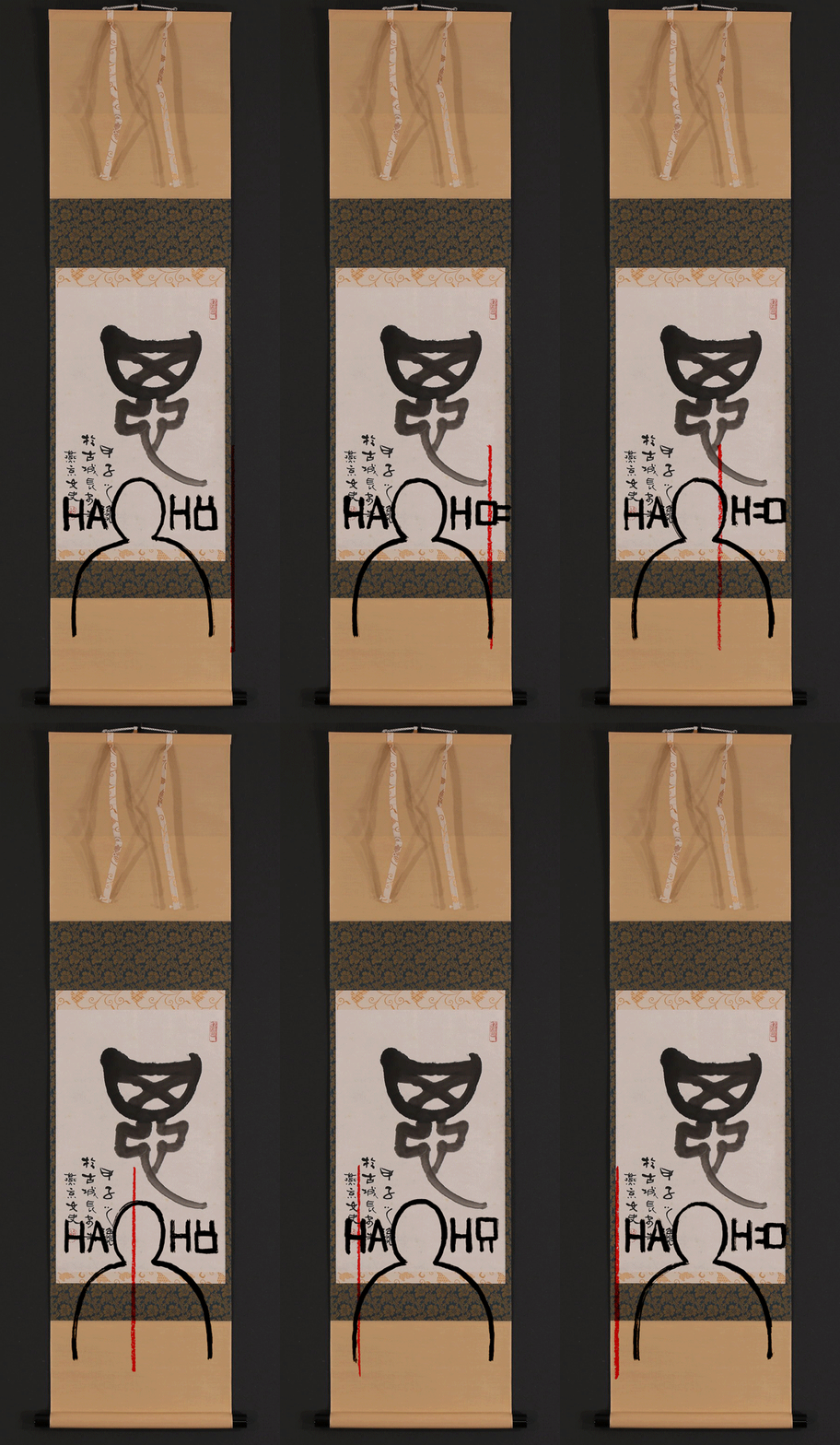

collection : FIAPCE  
 detail
 A Person Looks At A Work Of Art/
 someone looks at something... 
         
 LOGOS/HA HA


17 October 2016

Theatre of the Animals of Regard : Why Listen to Animals?

           
This experimental project by Liquid Architecture reframes English writer and artist John Berger’s classic 1980 essay Why Look at Animals? through the prism of sound and listening. We gather together artists, musicians, scientists and historians to investigate human-animal sound via the dynamics of power, knowledge and value in the pursuit of a new question : Why Listen to Animals?

In partnership with West Space, Melbourne Fringe Festival, Naturestrip, Australian Indigenous Studies Program at the University of Melbourne

Supported by City of Melbourne

artists :

Eric Avery, Eugene Brockmuller, Alex Cahill, Catherine Clover and Peter Knight, Melissa Deerson with Georgina Criddle, Will Foster and Sabrina D’Angelo, Tamsen Hopkinson, John Jenkin, Max Kohane, Nicholas Kuceli, Tessa Laird, Bunna Lawrie, Camila Marambio, Anthony Magen, Joel Maripil, Sally Ann McIntyre, Louis Kennedy, Miranda Liebscher, Julia McFarlane, Jake Moore, Lynn Mowson and Bruce Mowson, Bryan Phillips, Jack Prendergast, Kim Satchell, Undine Sellbach & Stephen Loo, Rob Thorne, James Utting-webb and Riley Lockett, Cecilia Vicuña, John-Joe Wilson.
     
schedule : look at / listen to CLICK

               
FIAPCE   -1976-  
Theatre of the Animals of Regard  
 detail
 A Person Looks At A Work Of Art/
 someone looks at something... 
         
 LOGOS/HA HA


16 October 2016

Theatre of the Abattoirs of Regard

                   
To express one's disgust 
        toward another person, 
                toward Donald Trump say, 
or one's disgust
        toward another section of human persons, 
                toward women say ,
by further denigrating 
        yet another group
                of our fellow sentient beings :
Hey,
        what's with that, 
                people?!

Theatre of the Abattoir of Regard : 

script
     
(he is) a disgusting pig
(she is) Miss Piggy
(he is) an animal
(he is) a dog
(she is my) bitch
(her) pussy
(he is) a f***ing  monkey
(he is) a slug
(he is) an orange slug
(he is) a revolting slug :
        
TAR : NSW Parliament Officially Calls Donald Trump 'Revolting Slug' : Hansard

That this House:
(a) condemns the misogynistic, hateful comments made by the Republican candidate for President of the United States of America, Mr Donald Trump, about women and minorities, including the remarks revealed over the weekend that clearly describe sexual assault;
(b) reflects on the divisive, destructive impact that hate speech from political candidates and members of elected office has on our community; and
(c) agrees with those who have described Mr Trump as "a revolting slug" unfit for public office.
Theatre of the Abattoir of Regard : 
execution
            

Theatre of the Abattoir of Regard  
 detail
 A Person Looks At A Work Of Art/
 someone looks at something... 
         
 LOGOS/HA HA
          
        
 Post Script : on cue... 


12 October 2016

Pierre and The Breakers ('Kill the Father!')

     
LOGOS/HA HA

Paterson (interior intergenerational dialog)
Pater (father) & Son (son of the father) :
"Sell Blue Poles to reduce the Budget debt."
       

Senator Paterson : maiden speech 
         
Theatre of the Accountants of Regard
at the 1850-51 Paris Salon, by CHAM/Le Charivari
         

Theatre of the Actors of Regard 
 detail
 A Person Looks At A Work Of Art/
 someone looks at something... 
         
 LOGOS/HA HA
            
Father & Son regard Les Casseurs de pierres
(The Stone Breakers) by Courbet.
Son : "Pourquoi donc, papa, qu'on appelle ça de la peinture socialiste?" ("Father, why do we call that a socialist painting?")
Father : "Parbleu : parce qu'au lieu d'être de la peinture riche, c'est de la pauvre peinture!" ("Crikey!  Because instead of it being a rich painting, it's a poor painting.")

The meta-Breakers

The Stone Breakers (French: Les Casseurs de pierres) was an 1849–50 painting by the French painter Gustave Courbet. It was a work of social realism, depicting two peasants, a young man and an old man, breaking rocks. The painting was first exhibited at the Paris Salon of 1850. 
       
centre : Les Casseurs de pierres / The Stone Breakers  
It was destroyed during World War II, along with 154 other pictures, when a transport vehicle moving the pictures to the castle of Königstein, near Dresden, was bombed by Allied forces in February 1945.  
- Wikipedia
        
PIERRE, TU ES PETRUS
and upon this rock
I will break
it all
            
 detail
 A Person Looks At A Work Of Art/
 someone looks at something... 
         
 LOGOS/HA HA


09 October 2016

Blue Polls Plebs Sight

             
Senator James Paterson advocates that Blue Ties be sold to reduce the Budget debt a bit.


Senator Paterson 
And are you in favour of the $200million same-sex marriage plebiscite rather than a direct vote in the Parliament, he was asked. Yes, he said. Go figure.
             

Theatre of the Actors of Regard 
 detail
 A Person Looks At A Work Of Art/
 someone looks at something... 
         
 LOGOS/HA HA


08 October 2016

view


"It is difficult to grasp the cultural devastation that is occurring across Australia. Even a partial glimpse is unnerving; surveying the whole is depressing beyond words. Despite the fact that in 2015 Australia's per capita purchasing power ranked 15th among the 25 wealthiest countries in the world, we are living in a nation in which poverties of every kind are being imposed from above.

In 2016 it became clear that Australian arts are facing the worst crisis since before the Australia Council was founded in 1967. But that is only a part of the story. The past three years have seen an unremitting ideological war on knowledge, inquiry and, significantly, cultural memory."


- 
Opening paragraphs of 'Culture Crisis : Critical failure and the Australian malaise' by Alison Croggon writing in The Monthly (October 2016)

That's your cue, James Paterson :

'Budget position... sell Blue Poles.'


Senator James Paterson
B. Commerce, BA (Melb).
Vice-President, Melbourne University Liberal Club 2008
Vice-President, Australian Liberal Students' Fed. 2008-2009
President, Young Liberal Movement (Vic) 2009.
Office of
Senator Mitch Fifield* 2006-2010
(*present Minister for the Arts) 
Victorian Employer's Chamber of Commerce & Industry 2010-11
Institute of Public Affairs 2011-16
Liberal Party senator in the Turnbull government 2016-


Gough Whitlam, Prime Minister of Australia 1972-75
Authorised purchase of Jackson Pollock's Blue Poles, 1973
          
Senator, I served with Jack Kennedy. 
I knew Jack Kennedy. 
Jack Kennedy was a friend of mine. 
Senator, you're no Jack Kennedy. 
      
- Democrat Senator Bentsen to Republican Senator Quayle : remark made during the 1988 United States vice-presidential debate


 detail 
 A Person Looks At A Work Of Art/
 someone looks at something... 
         
 LOGOS/HA HA
 
       
Meanwhile, just announced on another planet : 

France’s arts and culture sector will receive its largest amount of federal funding ever starting next year, with the allotted budget for the Department of Culture and Communication set to increase to €3.6 billion (~USD 4 billion). The leap of 5.5% marks the greatest boost in government financial support for the arts since 2010; the department’s budget now comprises 1.1% of that of the entire state.

The announcement arrived at the end of last month during Culture Minister Audrey Azoulay’s presentation of her department’s forthcoming budget, and makes good on President François Hollande’s announcement in July that a substantial increase was in the works. In her speech, Azoulay suggested that the renewed focused on culture was a response to the terrorism France has witnessed over the past year — from last November’s coordinated attacks across Paris to the devastating violence that shook Nice during this summer’s Bastille Day celebrations.

“I know the difficulties confronting museums today, between a drop in attendance, particularly linked to the drop in tourism, and a rise in security expenses,” Azoulay said, according to the Art Newspaper. As part of the new budget, museums will receive a 7% increase in annual funding.

France’s decision follows another recently announced, huge government effort to promote the arts nationwide: in April, Canadian officials pledged to invest almost CAD 1.9 billion (~USD 1.4 billion) into its own cultural industries over the next five years.


 Looking at Jackson Pollock's Blue Poles, NGV 1974
Theatre of the Actors of Regard
Fosterville Institute of Applied & Progressive Cultural Experience
 detail 
 A Person Looks At A Work Of Art/
 someone looks at something... 
         
 LOGOS/HA HA


06 October 2016

Comedia : the Guides of TAR

         
Inferno (pronounced [inˈfɛrno]; Italian for "Hell") is the first part of Dante Alighieri's 14th-century epic poem Divine Comedy. It is followed by Purgatorio and Paradiso. The Inferno tells the journey of Dante through Hell, guided by the ancient Roman poet Virgil. In the poem, Hell is depicted as nine circles of suffering located within the Earth; it is the "realm...of those who have rejected spiritual values by yielding to bestial appetites or violence, or by perverting their human intellect to fraud or malice against their fellowmen."[1] As an allegory, the Divine Comedy represents the journey of the soul toward God, with the Inferno describing the recognition and rejection of sin.[2] - Wikipedia

Today's Hyperallergic article, Hiroshi Sugimoto’s Otherworldly Photographs of Movie Theaters was received with much interest. It begins :
    
The question that Hiroshi Sugimoto asked himself in 1976, as a 28-year-old photographer influenced by Zen Buddhism, sounded a bit like a koan: What happens if you shoot a whole movie in a single frame? To discover the answer, he smuggled a large-format camera into the rundown St. Marks Cinema in Manhattan’s East Village and set it up at the back of the theater. The exposure time was the full length of the film; the only light used was that from the running projector. The resulting photograph gave him the answer he wanted: The gleaming white screen looked like a portal to another dimension.


 Hiroshi Sugimoto, Goshen, Indiana (1980)
          
The day delivers what the day delivers. Following on from the previous post, from the Chordettes of TAR to Hakuin, to the TARettes, today we've been recalling certain ushers and usherettes from the picture theatres of 1950s and 60s Bendigo - the Lyric, the Princess and the Plaza. 

 Plaza, Bendigo (1938)

'Plaza Jack' (Jack Campbell), with his braces and torch, often seen riding his simple old bicycle to and from work, was the best known of these local cinema guides.

Princess Theatre, Bendigo  "...was compared to Melbourne's finest theatres and even the theatres of Drury Lane in London. But in 1963, after being sold to American Oil Company Amoco, it was torn down to make way for a service station and car park."
     
Just a few years later, your correspondent also achieved that inner admission, as a 35mm film projectionist.

P.T. -1966-   
Back to the TARettes. Below is a commercially available, life size TAR tableau. Ostensibly a menu guide, a white blonde model woman in costume USA directs her torch at the Four Square mystery deal of Malevich in black America.


Theatre of the Actors of Regard  
detail 
A Person Looks At A Work Of Art/
someone looks at something... 
         
LOGOS/HA HA
 
Set the Controls for the Heart of the Sun. (1968)
The theme du jour continues through to midnight when SBS screens the Danny Boyle sci-fi sun-seekin' thriller Sunshine. Quite a 24 hour ride!

Theatre of the Actors of Regard  
detail 
A Person Looks At A Work Of Art/
someone looks at something... 
         
LOGOS/HA HA


03 October 2016

Chordettes of TAR

 
... of Theatre of the Actors of Regard  
... of TAR

after Hakuin  
detail 
A Person Looks At A Work Of Art/
someone looks at something... 
         
LOGOS/HA HA