David Jones, artist and poet (1895-1974) begins his PREFACE TO THE ANATHEMATA :
'I have made a heap of all that I could find.' (1) So wrote Nennius, or whoever composed the introductory matter to Historia Brittonum. He speaks of an 'inward wound' which was caused by the fear that certain things dear to him 'should be like smoke dissipated'. Further, he says, 'not trusting my own learning, which is none at all, but partly from writings and monuments of the ancient inhabitants of Britain, partly from the annals of the Romans and the chronicles of the sacred fathers, Isidore, Hieronymous, Prosper, Eusebius and from the histories of the Scots and Saxons although our enemies . . . I have lispingly put together this . . . about past transactions, that [this material] might not be trodden under foot'. (2)
(1) The actual words are coacervavi omne quod inveni, and occur in Prologue 2 to the Historia.
(2) Quoted from the translation of Prologue 1. See The Works of Gildas and Nennius, J.A.Giles, London 1841.
No wonder artists such as Lautrec and Van Gogh were so impressed when they encountered works like this by Hokusai. Here, too!
 Late Edo period, Japan. The famous artist Hokusai (he changed his name thirty times e.g. from 1834 :
Gakyō Rōjin Manji/The Old Man Mad About Art)
paints onto silk the scene of an unsung painter applying fresh coal black to the base of a red pillar.


 Katsushika Hokusai (1760–1849) : seal worthy of our best tagger
Monash University, Clayton, 1975. The brand new Department of Visual Arts' first artist-in-residence FIAPCE (also known by various other names) photographs the scene of an unsung painter applying white paint to a red post.
 detail
A Person Looks At A Work Of Art/
someone looks at something...
LOGOS/HA HA
[Painting Red Posts White]
That's the way, aha, aha
I like it, aha, aha
That's the way, aha, aha
I like it, aha, aha
That's the way, aha, aha
I like it, aha, aha
That's the way, aha, aha
I like it, aha, aha

scene from Theatre of the Actors of Regard drawing :
Regarding a Practitioner of the Great Brush of Three Hairs
That's the way, aha, aha
I like it, aha, aha
That's the way, aha, aha
I like it, aha, aha
That's the way, aha, aha
I like it, aha, aha
That's the way, aha, aha
I like it, aha, aha
 scene from 1975 FIAPCE disco drawing :
The Brush Off (Lao Tse and the Sunshine Band)
That's the way, aha, aha
I like it, aha, aha
That's the way, aha, aha
I like it, aha, aha
That's the way, aha, aha
I like it, aha, aha
That's the way, aha, aha
I like it, aha, aha
detail
A Person Looks At A Work Of Art/
someone looks at something...
LOGOS/HA HA
HAKUIN
paints an enso
to help us see

Hakuin Ekaku (1686 - 1768)
HENRY NO LOGOS
Henry is a comic strip created in 1932 by Carl Anderson. The title character is a young bald boy who is mute (and sometimes drawn minus a mouth). With the exception of a few early episodes, the comic strip character communicates only through pantomime, a situation which changed when Henry moved into comic books. (Wikipedia)
Henry steps onto the set of
I Am Comic Curious (Yellow)
He is carrying a framed portrait by Carl Anderson,
a can of black paint and a brush.
Henry hangs the portrait on his free-floating name.
Henry turns to face us.
Henry paints an enso round his right eye.

Henry turns back to face the portrait.
Henry paints an enso round the portrait's right eye.
 Standing beside the portrait, Henry regards us.
This is
Black Hole Henry's Meta-Portrait Enso Show
painted to help us see
Henry exits stage right
detail
A Person Looks At A Work Of Art/
someone looks at something...
LOGOS/HA HA
The Masks of Melbourne
Last weekend in Melbourne there were violent clashes again between the Theseans & Minotaurs.

AAP photo
The Police Commissioner and Minister for Police have since spoken out against the use of masks by these groups.
They propose that masks by protestors be banned.
This issue has been going on for some time...

ex libris FIAPCE (1973)
 Above, members of the two opposing groups pose for a drawing
detail
A Person Looks At A Work Of Art/
someone looks at something...
LOGOS/HA HA
We enjoyed and recommend Christopher Benfey's recent Wittgenstein’s Handles in the New York Review of Books. May 24, 2016 click here
 Door handles and lock by Ludwig Wittgenstein in the Vienna house he
designed (1926-1929) with architect Paul Engelmann - photo Studio
Hubert Urban, 1972
 FIAPCE, ideograms of dependent-arising (above) and The Two Truths
(see: Wittgenstein's Handles)
He begins with a question, to which he responds :
What was it about handles—door-handles, axe-handles, the handles of pitchers and vases—that transfixed thinkers in Vienna and Berlin during the early decades of the twentieth century, echoing earlier considerations of handles in America and ancient Greece?
From Wittgenstein...
To details like the door-handles, in particular, Wittgenstein accorded what Monk calls “an almost fanatical exactitude,” driving locksmiths and engineers to tears as they sought to meet his seemingly impossible standards. The unpainted tubular door-handle that Wittgenstein designed for Gretl’s house remains the prototype for all such door-handles, still popular in the twenty-first century.
 Theatre of the Actors of Regard, Seating Viewed in Upright Position
(The Admissions of Wittgenstein), 1951 - note door handle
(Thomas Bernhard was surely evoking his idol, Wittgenstein, when he told a friend that the only way to find an exact replacement for a broken window-handle would be to find another, identical broken window-handle.)
Monk argues, more than once, that this design project brought Wittgenstein “back” to philosophy.
to the German sociologist Georg Simmel...
In his brilliant 1911 essay “The Handle,” Simmel argued that the handle of a vase bridges two worlds,the utilitarian and the non-utilitarian.
 Pablo Picasso, Personnage avec mains sur les hanches (Vase with
two high handles), 1953 - note disparate translation handles
A vessel, according to Simmel, “unlike a painting or statue, is not intended to be insulated and untouchable but is meant to fulfill a purpose—if only symbolically. For it is held in the hand and drawn into the movement of practical life.”
Thus the vessel stands in two worlds at one and the same time: whereas reality is completely irrelevant to the “pure” work of art and, as it were, is consumed in it, reality does make claims upon the vase as an object that is handled, filled and emptied, proffered, and set down here and there. This dual nature of the vase is most decisively expressed in its handle.
to Emerson, Stanley Cavell, the Greek stoic philosopher Epictetus, Bob Dylan, Thomas De Quincey, Coleridge, Robert Frost, a French-Canadian woodcutter named Baptiste , Elizabeth Bishop’s Crusoe, Gary Snyder who recalls Elias Canetti...
Snyder invokes the idea of literary tradition as a “handing down,” from father to son and from teacher to student, “how we go on.” In such a transfer, the ax stands in for the pen (in a different context, Snyder compared a laptop to a nice little chainsaw). In his seductive praise of the “craft of culture,” Snyder recalls Elias Canetti’s moving assertion: “It is the quiet, prolonged activities of the hand which have created the only world in which we care to live.”
HAND SPACE manifesto, 1981
Is there some unfinished business here?
he asks, and continues...
Was there, for example, any significance to Wittgenstein’s parenthetical joke about handles resembling one another, like brothers and sisters? “We see handles all looking more or less alike. (Naturally, since they are all supposed to be handled.)” For Wittgenstein, those handles seem to come momentarily alive; they’re animated...
 Theseus at MoMA : Picasso, Tete de taureau (Bull's Head) 1942
A handle-horned minotaur...

awaits every Theseus...
in the labyrinth of TAR !

Theatre of the Actors of Regard
detail
A Person Looks At A Work Of Art/
someone looks at something...
LOGOS/HA HA
Hegel's Owl: The Life of Bernard Smith was launched last evening from 6-8pm at the Victorian Artists Society. At the fall of dusk, all flocked in.
In 2008 the prominent Australian art historian Bernard Smith invited Dr Sheridan Palmer to write his biography. Bringing together years of interviews and insight through exclusive access to Smith’s papers and library, Hegel’s Owl deftly reveals the unique character of an exceptional man, today acknowledged by many as the father of Australian art history.

- University Of Sydney, N.S.W. Power Publications, 2016
We received a reminder about this boobook launch immediately after posting yesterday's gif of the Black Hole Owl Collector.
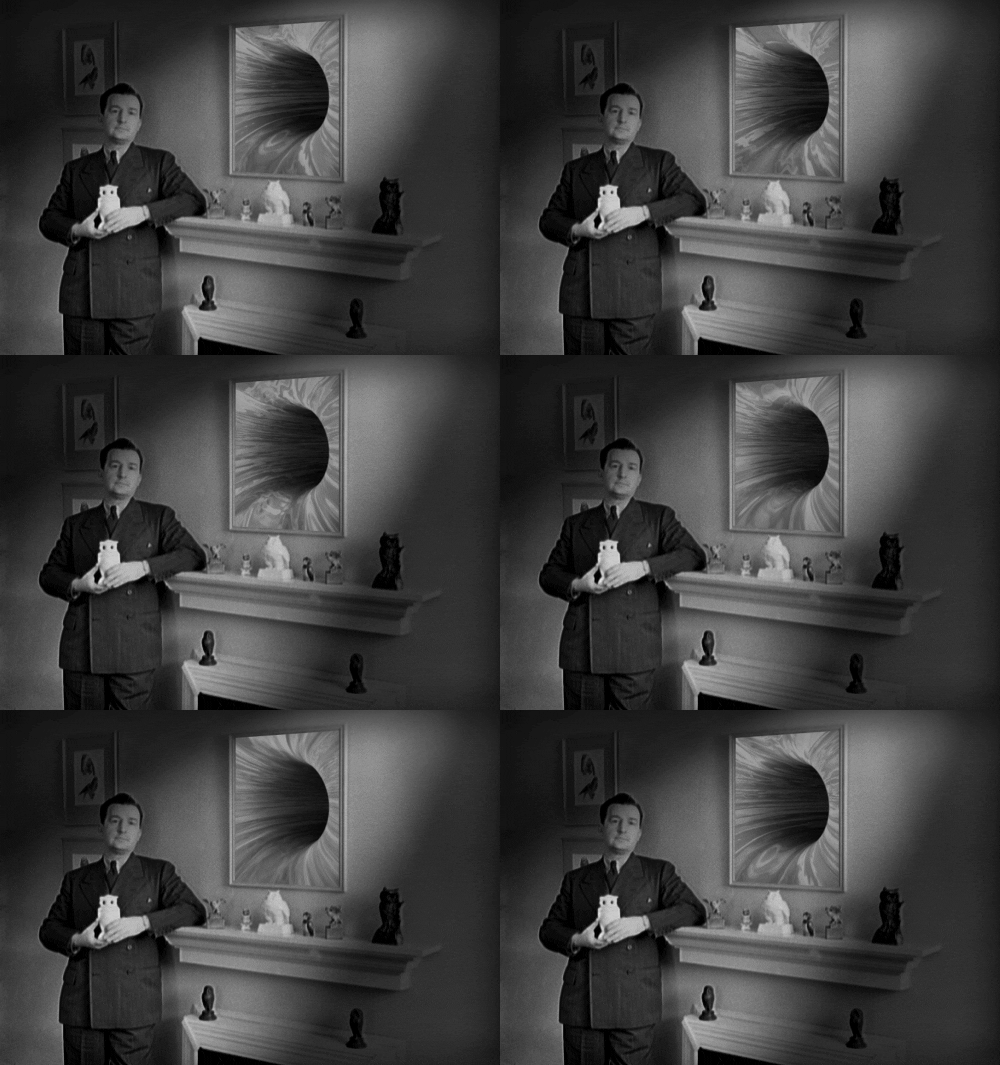
gif by Bill Domonkosis
H Owl here refers to this famous text by Hegel :
Um noch über das Belehren, wie die Welt sein soll, ein Wort zu sagen, so kommt dazu ohnehin die Philosophie immer zu spät. Als der Gedanke der Welt erscheint sie erst in der Zeit, nachdem die Wirklichkeit ihren Bildungsprozeß vollendet und sich fertig gemacht hat. Dies, was der Begriff lehrt, zeigt notwendig ebenso die Geschichte, daß erst in der Reife der Wirklichkeit das Ideale dem Realen gegenüber erscheint und jenes sich dieselbe Welt, in ihrer Substanz erfaßt, in Gestalt eines intellektuellen Reichs erbaut. Wenn die Philosophie ihr Grau in Grau malt, dann ist eine Gestalt des Lebens alt geworden, und mit Grau in Grau läßt sie sich nicht verjüngen, sondern nur erkennen; die Eule der Minerva beginnt erst mit der einbrechenden Dämmerung ihren Flug.
Hegel, Vorrede zu der Philosophie des Rechts
One more word about teaching what the world ought to be: Philosophy always arrives too late to do any such teaching. As the thought of the world, philosophy appears only in the period after actuality has been achieved and has completed its formative process. The lesson of the concept, which necessarily is also taught by history, is that only in the ripeness of actuality does the ideal appear over against the real, and that only then does this ideal comprehend this same real world in its substance and build it up for itself into the configuration of an intellectual realm. When philosophy paints its gray in gray, then a configuration of life has grown old, and cannot be rejuvenated by this gray in gray, but only understood; the Owl of Minerva takes flight only as the dusk begins to fall.
Hegel, Preface to the Philosophy of Right
H o w
N o w
B r o w n
O w l ?

Goya, El sueño de la razón produce monstruos (The Sleep of
Reason Produces Monsters), 1799
Howl this 1955 poem by Ginsberg :
"I saw the best minds of my generation destroyed by madness, starving hysterical naked,
dragging themselves through the negro streets at dawn looking for an angry fix,
angelheaded hipsters burning for the ancient heavenly connection to the starry dynamo in the machinery of night...
and grOWL Russolo verses Hendrix :
Black How
Black Now
Black Hole?
((( O )))
Black Audio Sun!
grOWL-ed
be thy radiant Goethe gray
- gray in gray -
theoria!
Although your world wonders me
With your majestic and superior cackling hen
Your people I do not understand
So to you I shall put an end
Then you'll never hear surf music again

reverse gif FIAPCE
detail
A Person Looks At A Work Of Art/
someone looks at something...
LOGOS/HA HA
Malevich meets
Malevich meets Fontana meets
Malevich meets Fontana meets Kapoor meets
Malevich meets Fontana meets Kapoor meets
Yves Klein meets The Void
Yves Klein meets The Void
gif by Bill Domonkosis
"...which ever way you look at it,
there's a black hole."
- Malcolm Turnbull, 25 May 2016
- Malcolm Turnbull, 25 May 2016
detail
A Person Looks At A Work Of Art/
someone looks at something...
LOGOS/HA HA

Theatre of the Actors of Regard
detail
A Person Looks At A Work Of Art/
someone looks at something...
LOGOS/HA HA
Kids Smash Art at Glass Museum While Adults Stand by Filming

Theatre of the Actors of Regard
detail
A Person Looks At A Work Of Art/
someone looks at something...
LOGOS/HA HA
Rod Moss
Origin of the New Poetics
| |
|
| |
| It was a great pleasure last weekend to attend the latest exhibition by Rod Moss and, on Saturday, to listen to him 'In Conversation' with Rex Butler. |

(left) Rex Butler and (right) Rod Moss and
"Families at Uleralkwe" "Considering The Birds"
From the discussion came even more to delight in, such as the link between the already wonderful
The Gift of Butterflies and Gustave Courbet's 1854 La rencontre, ou "Bonjour Monsieur Courbet" (The Meeting or "Bonjour, Monsieur Courbet").

Rod Moss, The Gift of Butterflies, 2015
"Rod Moss has lived in the Aboriginal community, Whitegate on the eastern fringes of Alice Springs, for almost three decades, forging close ties with the community. Breaking the barriers of what Moss considers “a politically correct, insulating silence” within the Australian art scene, Origin of the New Poetics depicts the people of Whitegate in extraordinarily personal, vulnerable and private moments.
Moss’ narrative paintings show resolute scenes in which the impact of alcohol and violence are unflinchingly depicted, contrasted with tender moments showing cultural milestones and family rituals. Appropriating compositions from the Old Masters and religious paintings, his artworks are familiar yet foreign, romantic yet confronting.
This is Moss’ fourth solo exhibition with Anna Pappas Gallery. Moss was awarded the Prime Minister’s Literary Award for Non-fiction in 2011 for his first memoir The Hard Light of Day. Moss’s second memoir, One Thousand Cuts: Life and Art in Central Australia was launched in conjunction with a retrospective exhibition at Anna Pappas Gallery in 2013"
Click here for more exhibition images
Click here to view flip-book catalogue
 Rod Moss, Origin of the New Poetics, 2015

|
Rod Moss, August We Meet Here To Talk About Water, 2014
|
|
After the conversation with Rex, Rod talked further about the Whitegate community. In 2014 the NT government turned their water off - read here and here and here and here - hence the title of this 2014 work, 'August We Meet Here To Talk About Water'.
Even in the last month further claim difficulties have emerged as the community attempts to gain a ‘special purpose lease’ over the Uleralkwe land (the other 16 town camps all have it).

click photo to enlarge
detail
A Person Looks At A Work Of Art/
someone looks at something...
LOGOS/HA HA


