David Jones, artist and poet (1895-1974) begins his PREFACE TO THE ANATHEMATA :
'I have made a heap of all that I could find.' (1) So wrote Nennius, or whoever composed the introductory matter to Historia Brittonum. He speaks of an 'inward wound' which was caused by the fear that certain things dear to him 'should be like smoke dissipated'. Further, he says, 'not trusting my own learning, which is none at all, but partly from writings and monuments of the ancient inhabitants of Britain, partly from the annals of the Romans and the chronicles of the sacred fathers, Isidore, Hieronymous, Prosper, Eusebius and from the histories of the Scots and Saxons although our enemies . . . I have lispingly put together this . . . about past transactions, that [this material] might not be trodden under foot'. (2)
(1) The actual words are coacervavi omne quod inveni, and occur in Prologue 2 to the Historia.
(2) Quoted from the translation of Prologue 1. See The Works of Gildas and Nennius, J.A.Giles, London 1841.
'The Expanding and Contracting Universe of Painting'
Roundtable discussion
Tuesday 9 June 2015, 6–8pm
Gertrude Contemporary
‘The Expanding and Contracting Universe of Painting’ is a roundtable discussion about the specificity of contemporary painting practices that are proximal to sculptural and installation practices. Each speaker will present a short statement, followed by an open discussion.
'The Expanding and Contracting Universe of Painting' is the first in a series of discussions about contemporary painting organised by Fayen d'Evie and Liang Luscombe, which will take place at Gertrude Contemporary.
Speakers:
Brooke Babington
Jan Bryant
Gabriel Curtin
Ry Haskings
David Homewood
Helen Johnson
Annika Koops
Lucina Lane
Nell Pearson
Lisa Radford
Bryan Spier
Nick Selenitsch
Masato Takasaka
Moderator:
Helen Hughes
We couldn't get there so listened instead to our very worn vinyl original of ] I'M ( STRANDED by THE PAINTS, released in Australia in 1977 by Reductivist Crisis records. A classic!

AAA_ Art Archive Australia
detail
A Person Looks At A Work Of Art/
someone looks at something...
LOGOS/HA HA
starring
Dr. Cornel West
as seen on Q & A
'Justice is what love looks like in public'
'Deep education requires a habitual vision of greatness.'
'You can't lead the people if you don't love the people. You can't save the people if you don't serve the people.'

Q & A, Monday 8 June, 2015
detail
A Person Looks At A Work Of Art/
someone looks at something...
LOGOS/HA HA
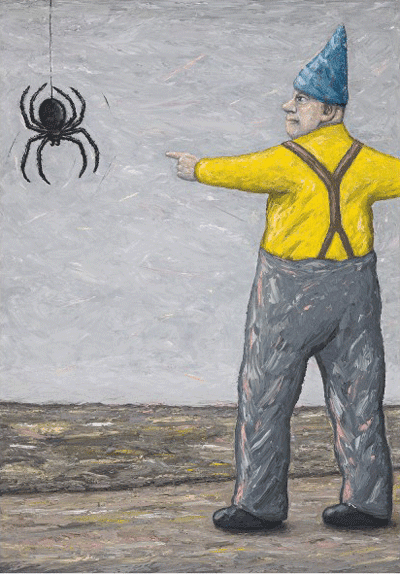
Last time, we visited the Court of the fool king Theoria Rex, attended on one side by WC Chain and on the other by Laughing Lord Spider.
 We do have an affection for such characters. King Canute, for instance.

click the image to enlarge
It was another dubbed royal, Nat 'King' Cole, who popularised the wisdom of 'Nature Boy'.
There was a boy
A very strange enchanted boy
They say he wandered very far
Very far, over land and sea
A little shy and sad of eye
But very wise was he
And then one day, a magic day
He passed my way, and while we spoke
Of many things, fools and kings
This he said to me
'The greatest thing you'll ever learn
Is just to love and be loved in return'
 click on the image above to hear it sung by the one who wrote it, eden abhez :
George Alexander Aberle, known as eden ahbez (15 April 1908 – 4 March 1995), was an American songwriter and recording artist of the 1940s to 1960s, whose lifestyle in California was influential on the hippie movement. He was known to friends simply as ahbe.
Ahbez composed the song "Nature Boy," which became a No. 1 hit for eight weeks in 1948 for Nat "King" Cole and has since become a pop and jazz standard.
Living a bucolic life from at least the 1940s, he traveled in sandals and wore shoulder-length hair and beard, and white robes. He camped out below the first L in the Hollywood sign...
Hey, that's our kinda guy!
...above Los Angeles and studied Oriental mysticism. He slept outdoors with his family and ate vegetables, fruits, and nuts. He claimed to live on three dollars per week.
Ahbez was born in Brooklyn, New York, to a Jewish father and a Scottish-English mother, and spent his early years in the Brooklyn Hebrew Orphan Asylum of New York, which branched off from the Hebrew Orphan Asylum. He was then adopted, in 1917, by a family in Chanute, Kansas, and raised under the name George McGrew.
During the 1930s, McGrew lived in Kansas City, where he performed as a pianist and dance band leader. He probably also lived in New York City for some time, although little is known of that period of his life. In 1941, he arrived in Los Angeles and began playing piano in the Eutropheon, a small health food store and raw food restaurant on Laurel Canyon Boulevard. The cafe was owned by John and Vera Richter, German immigrants who followed a Naturmensch and Lebensreform philosophy influenced by the Wandervogel movement in Germany. He was a vegetarian. He recalled once telling a policeman: I look crazy but I'm not. And the funny thing is that other people don't look crazy but they are.
Their followers, known as "Nature Boys" and who included Robert "Gypsy Boots" Bootzin, wore long hair and beards and ate only raw fruits and vegetables. During this period, he adopted the name "eden ahbez," choosing to spell his name with lower-case letters, claiming that only the words God and Infinity were worthy of capitalization. He is also said to have desired the A and Z (alpha and omega), the beginning and the end, in his surname.
- wikipdeia
John Barbour (1954-2011) had his cast of wise fool characters too : John Barbour, John de Silentio, Joao Solitaire, the dunce...
Which brings us to Painting 2015 by Peter Booth, from his current Melbourne exhibition :
photo : Karen Woodbury Gallery, Melbourne
detail
A Person Looks At A Work Of Art/
someone looks at something...
LOGOS/HA HA
Theoria Rex
] who with unblinking gaze (
Theoria : the act of looking, the act of regard
TAR : Theatre of the Actors of Regard
Theoria Rex : The Loo King
'I am the Loo King' : Anthem of the Loo King. Sung at the Court of TAR to the melody of Russell Morris's '
Real Thing' (1969).
Come and see the loo king, come and see the loo king, come and see
Come and see the loo king, come and see the loo king, come and see
There's a meaning there, but the meaning there doesn't really mean a thing
Come and see the loo king, come and see the loo king, come and see
I am the loo king !
Oo mama mow-mow
Oo mama mow-mow
Oo mama mow-mow
Oo mama mow-mow

detail
A Person Looks At A Work Of Art/
someone looks at something...
LOGOS/HA HA
Oo mama mow-mow
Oo mama mow-mow
Oo mama mow-mow
Oo mama mow-mow
We're enjoying the Brandy Spoof Cocktail Hour at The George Brandis Live Art Experience.
A few faves...


The young George B and his pal Tony whitewash the border
detail
A Person Looks At A Work Of Art/
someone looks at something...
LOGOS/HA HA
re-present :
JOHN HEARTFIELD AND THE
AGITATED IMAGE
Photography, Persuasion, and the Rise
of Avant-Garde Photomontage
by Andrés Mario Zervigón
Suck My Cuts : this special re-edition book cover celebrates
the cut-and-paste Ministry of George Brandis QC, Director of Excellence and Efficiency Dividender to the Arts of Australia.
We Are All John Heartfield Now : Lots more GB cultural collage at The George Brandis Live Art Experience
Australians for Artistic Freedom : open letter to George Brandis - sign here George Brandis : The Australian Academy for Excellent Art : here Defining the Modern Australian Landscape : here
 Fosterville Institute of Applied & Progressive Cultural Experience
detail
A Person Looks At A Work Of Art/
someone looks at something...
LOGOS/HA HA
window (n.)
c. 1200, literally "wind eye," from Old Norse vindauga, from vindr "wind" (see wind (n.1)) + auga "eye" (see eye (n.)). Replaced Old English eagþyrl, literally "eye-hole," and eagduru, literally "eye-door."
Originally an unglazed hole in a roof, most Germanic languages adopted a version of Latin fenestra to describe the glass version (such as German Fenster, Swedish fönster), and English usedfenester as a parallel word till mid-16c. Window dressing is first recorded 1790; figurative sense is from 1898. Window seat is attested from 1778. Window of opportunity (1979) is from earlier figurative use in U.S. space program, such as launch window (1963). Window-shopping is recorded from 1904.
"Window shopping, according to the women, is the king of outdoor sports. Whenever a woman gets down town and has 2 or 3 hours and no money to spend, she goes window shopping. She gives the Poiret gowns and the thousand dollar furs the double O and then kids herself into believing she'd look like Lillian Russell or Beverly Bayne if she had 'em on. It's great for developing the imagination and one of the great secrets of conserving the bankroll. ..." ["Motor Age," Jan. 27, 1916]
In the early 1950s, a 'returned serviceman' chemist set up shop next to the Kangaroo Flat Post Office (see previous POST).
 A few years later, as the post-WW2 austerity gave way to a new hopefulness, the chemist bought the premises next door and built a large modern Pharmacy and Gift Palace.
 Sometimes, a young family could be seen there, looking at the things in the window display.
 Sometimes, one can still see them, at large in the world, window shopping...
 collection: Museum of Contemporary Art, Sydney
detail
A Person Looks At A Work Of Art/
someone looks at something...
LOGOS/HA HA
In researching the previous blog post
about post offices...
Hmmm : why "post"?
post (n.1)
"a timber set upright," from Old English post "pillar, doorpost," and Old French post "post, upright beam," both from Latin postis "door, post, doorpost," perhaps from por- "forth" (see pro-) + stare "to stand," from PIE root *sta- "to stand, set down, make or be firm" (see stet). Similar compound in Sanskrit prstham "back, roof, peak," Avestan parshti "back," Greek pastas "porch in front of a house, colonnade," Middle High German virst "ridepole," Lithuanian pirstas, Old Church Slavonic pristu "finger" (PIE *por-st-i-).
post (n.2)
"place when on duty," 1590s, from Middle French poste "place where one is stationed," also, "station for post horses" (16c.), from Italian posto "post, station," from Vulgar Latin *postum, from Latin positum, neuter past participle of ponere "to place, to put" (see position (n.)). Earliest sense in English was military; meaning "job, position" is attested 1690s.
post (n.3)
"mail system," c. 1500, "riders and horses posted at intervals," from post (n.2) on notion of riders and horses "posted" at intervals along a route to speed mail in relays, probably formed on model of Middle French poste in this sense (late 15c.). Meaning "system for carrying mail" is from 1660s.
Aha! That supports Tim's theory. We were wondering about the public seating in this mid-1960s photo : set above the gutter and facing towards the road outside the Kangaroo Flat Post Office.

We recalled it was a Bus Stop. Tim suggested it might be sited there as a continuation from the days when the Melbourne-Bendigo Cobb & Co mail coach would stop at each post/office.
Anyway, in researching our previous blog post about post offices, we found online at
vimeo a very interesting 90 minute interview with the artist Robert MacPherson.

l - r : Michele Helmrich, Robert MacPherson, Rex Butler
An Evening with Robert MacPherson
The University of Queensland Art Museum
1 May 2013
In it, MacPherson talks at length and in great detail about his art. And, in a note towards the end, explains why one year he sent 3000 items through the Hepburn Springs Post Office and received in return a thank you letter from postmistress Debbie.

33 envelopes from Bob (23 January 2007)
detail
A Person Looks At A Work Of Art/
someone looks at something...
LOGOS/HA HA
Hepburn Springs Post Office closed today.
Imperceptibly, the centre of the township moved south. The Hepburn Post Office, in use for just over 100 years, now stands a mile or more from the township of Hepburn Springs.

The above photo was taken in 1964, not long before the Post Office closed. For nearly 30 years, from 1869 to 1896, members of the Hill family were Postmasters from this building. Today the building survives; instead of a grocery store, or bootmaker's, it is now a B & B.
In 1908, at a time when tourism to the area was beginning to boom, a Receiving Office was established in Hepburn Springs.
Then, for over fifty years, from 1910 until Hepburn closed its doors in 1964, there were the twin post offices of Hepburn, and Hepburn Springs.
Originally post was picked up from the Police Camp at Hepburn then the Postal Service (in 1854) was in a building where Mooltan is now, it was soon relocated to Old Hepburn to what I believe was the building in your photo (above).
A new Hepburn Springs post office was established in a tiny timber building once on the East side of Main Rd and then moved next to the now General Store. Mr Perini later built the current post office as a newsagent - gift shop - post office.
- local historian Gary Lawrence
Post Office photos from National Archives
Last year, our Hepburn Springs staff photographer gave to QAGOMA a hoard of about 13,000 postal items received over 35 years from the artist Robert MacPherson. These were part of a correspondence between the two, sent and received through the Toowong (QLD 4066) and Hepburn Springs (VIC 3461) post offices.

staff photographer
detail
A Person Looks At A Work Of Art/
someone looks at something...
LOGOS/HA HA
POST script : click the links below
Can I ask you something, madam.
I was here to see this display window,
And...


detail
A Person Looks At A Work Of Art/
someone looks at something...
LOGOS/HA HA