David Jones, artist and poet (1895-1974) begins his PREFACE TO THE ANATHEMATA :
'I have made a heap of all that I could find.' (1) So wrote Nennius, or whoever composed the introductory matter to Historia Brittonum. He speaks of an 'inward wound' which was caused by the fear that certain things dear to him 'should be like smoke dissipated'. Further, he says, 'not trusting my own learning, which is none at all, but partly from writings and monuments of the ancient inhabitants of Britain, partly from the annals of the Romans and the chronicles of the sacred fathers, Isidore, Hieronymous, Prosper, Eusebius and from the histories of the Scots and Saxons although our enemies . . . I have lispingly put together this . . . about past transactions, that [this material] might not be trodden under foot'. (2)
(1) The actual words are coacervavi omne quod inveni, and occur in Prologue 2 to the Historia.
(2) Quoted from the translation of Prologue 1. See The Works of Gildas and Nennius, J.A.Giles, London 1841.
.
regarding certain fpm definitions
pencil : means of transport

with thanks to Eric B
detail
A Person Looks At A Work Of Art/
someone looks at something ...
LOGOS/HA HA
.
Announced today, the new fpm pen/cil range :
C RIT (French) IC
SEE LAUGH (English) I/EYE SEE

click image to enlarge
fpm :) always with a smile

detail
A Person Looks At A Work Of Art/
someone looks at something ...
LOGOS/HA HA
.
This letter (18 May) to The Age ...
IF I was running the NGV, I would also ban the wearing of bifocal glasses. How dare those people get two views of the same works.
Brad Hooper, Drummond
.... refers first to the NGV ban on sketching, note-making and photography within the Fred Williams retrospective and second to the review of that exhibition by Age critic Robert Nelson and the subsequent response to that by Ronald Millar.
When we quoted the letter earlier, we suggested
If we were dictator, we would make mindview-bifocals the minimum permissible aids of regard, and would encourage the use of mindview-polyfocals
Now this free pencil movement blotter reminds us of best practice regard: The Two Truths.
By this aid to clear seeing, the object of regard is BOTH relative ['good' (Millar, McCaughey) / 'bad' (Nelson, Davila)] AND absolute, empty of any inherence.
Q E D / L O L
detail
A Person Looks At A Work Of Art/
someone looks at something ...
LOGOS/HA HA
with fpm
free pencil movement
+ get straight to the point !
detail
A Person Looks At A Work Of Art/
someone looks at something ...
LOGOS/HA HA
.
Today GOOGLE observes the 78th Birthday of Robert MOOG, inventor of the famous MOOG synthesizer.
A bLOGOS/HA HA staffer recalls attending a Melbourne CAE (Council of Adult Education) class in the early 1970s at which Felix Werder explained and demonstrated the then newly available Minimoog.
Felix Werder on the set of Music Workshop, 1966
A great contributor to Melbourne's rich musical matrix, Felix Werder died on 3 May.
On 23 February he had celebrated his 90th birthday at a peer-packed tribute concert. On the bill that night, at the Iwaki Auditorium, Melbourne :
Dice (solo piano), Felix Werder - World premiere
H Factor : string quartet, Felix Werder - World premiere - performed by Silo String Quartet
Ill Tempered Clavier (solo piano), Felix Werder - Australian premiere - performed by Michael Kieran Harvey
Quinny on the Roof : percussion, Felix Werder
Recipe for disaster : percussion (2000), Felix Werder - performed by Eugene Ughetti
The Tempest : electronics by Felix Werder
Friend and fellow composer Warren Burt wrote this obituary in The Age :
Champion of the new tweaked conservative noses
... He was an ardent champion of the new, and frequently delighted in tweaking the noses of his conservative, middle-class audience. Never one to suffer fools gladly, he brought a sense of forthright aesthetic debate into Australia. To his aesthetic opponents he could be a formidable adversary, but to those he worked with, both musically and educationally, he was unfailingly polite...
read full article here
Warren Burt
9 May 2012
Larry Sitsky on Werder (Post–1945 Modernism Arrives in Australia) :
Some years after writing Australian Piano Music of the Twentieth Century, I find myself in a quandary yet again, faced with the problem of writing about Felix Werder...
article here
detail
A Person Looks At A Work Of Art/
someone looks at something ...
LOGOS/HA HA
.
Master of four-string funk built the solid base of Memphis soul
Duck Dunn, whose simple but inventive bass playing anchored numerous hit records and helped define the sound of Memphis soul music, died early Sunday in Tokyo, where he had been on tour. He was 70.
Peter Keepnews / NYTIMES
13 May 2012
 "Mr. Dunn’s playing was an essential element of the Stax sound."
1967 schoolboy tribute ( P.T. )
click image to enlarge
detail
A Person Looks At A Work Of Art/
someone looks at something ...
LOGOS/HA HA
.
Day 7 : another Letter to the Age
Nelson was right
THERE have been a number of conservative responses to Robert Nelson's review (here) of the Fred Williams exhibition at the National Gallery of Victoria (Arts, 8/5), in which he challenged the received view of the painter's work. The mild English modernity that Williams represented conveys a feeling similar to that experienced when viewing the work of early English painters who depicted the Australian landscape in a distorted manner that became gospel. Nelson rightly implies that Williams did not address the unconscious, the truth of place that cannot be objectified.
Juan Davila, Malvern East
detail
A Person Looks At A Work Of Art/
someone looks at something ...
LOGOS/HA HA
.
For the sixth day, more letters to The Age about art matters in Melbourne.
Today, Patrick McCaughey on Robert Nelson's review of Fred Williams: Infinite Horizons at the National Gallery of Victoria. We had our two bobs worth on this yesterday.
A truly gifted painter
AUSTRALIAN art criticism hit a new low with Robert Nelson's review (Arts, 8/5) of the Fred Williams retrospective, Infinite Horizons, at the National Gallery of Victoria. The mendacity of the tone epitomised in such phrases as ''pompous modernist landscapes'', seascapes that ''look like wine labels'', ''these dull spotty things'' and ''cack-handed'' strongly suggest that Nelson was out to crush a reputation rather than review an exhibition. It would appear he only understands landscapes with a photographic likeness to nature, or why else the absurd complaint that Williams' trees do not cast shadows? When he claims that Williams was ''not a natural painter'', we know we are in the hands of the ignorant. Williams was an innately gifted painter who saw and sensed the world in paint. He has left us with an astonishing record of landscapes from the coastal plains of Victoria to the Bass Strait Islands, the Glasshouse Mountains in Queensland and the Pilbara.
Patrick McCaughey, former National Gallery of Victoria director, New Haven, US
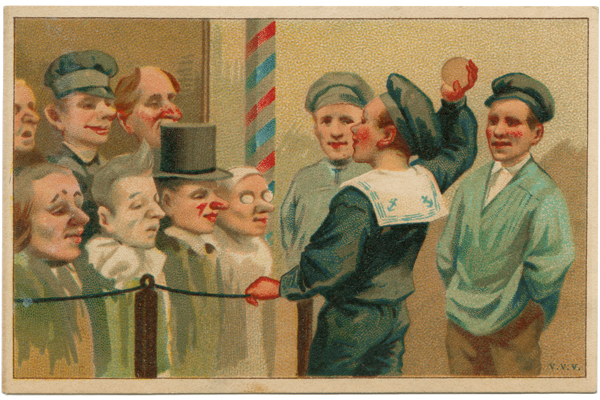
Knock-em Downs, circa 1890 (courtesy Theatre of the Actors of Regard)

click image to enlarge
detail
A Person Looks At A Work Of Art/
someone looks at something ...
LOGOS/HA HA
.
Who would have guessed that people demanding the right to write and draw in their State gallery would rate as one of The Age's topics of the week, even achieving a front page article.
Here's another Letter to the Editor, from yesterday's Age.
Pencil us in
OVER 40 years, I've been lucky enough to draw in some of the biggest and smallest museums all over the world. A sketchbook is my constant travel companion. Images once sketched are never forgotten. There is camaraderie between artists drawing in art galleries. At the Lahore Museum in Pakistan, cups of tea were offered and a curator talked about objects as I sketched them. An attendant brought me a chair - very civilised! I have been hounded out of only two galleries - Toronto's Royal Ontario and the NGV in my native Melbourne. At an NGV exhibition, three attendants heavied me when I began to draw a Joseph Hoffman gilt brass bowl. I knew that I had seen it before. At home, I trawled through old sketchbooks and found the bowl, drawn on 31/7/1997 at the good old V&A in London. Keep drawing alive. Let artists draw, please.
Alexandra Copeland, Malvern East
Opposite that newspaper letter an article by painter and critic Ronald Millar :
Critical vision cloudy
IT'S a pity that Age critic Robert Nelson came away from the Fred Williams retrospective feeling sad. A critic's job is hard enough without being dragged along to shows that make you downright miserable. Yet I suspect he would have been vastly outnumbered by those who found the exhibition exhilarating.
read full article here
Millar's article is in response to The Age art critic Robert Nelson's review (below) of the Fred Williams retrospective :
Dogged dabs of a blobby dazzler
... The works lack atmospheric credibility and seem instead to be a dogged rehearsal of a style or manner. No feature in a Williams landscape has any anchorage: the trees have no shadow and nothing is rooted into its home. We find incongruous lines turning up on horizons or delineating the edge of trees. Spatially, they are incoherent, and little respect is paid to any botanical or geological formation.
In producing these dull spotty things, Williams was in a no-lose situation. If the works lack space, they could be lauded as abstract. If they show no sensitivity for foliage or shadow or air or water or rock, they could be credited with marvellous gestural independence and commitment to paint. And because the abstract tendency had no conceptual basis, the works could still be honoured as belonging to the great tradition of Australian landscape.
More problematically...
read full article here
To accompany the Millar critique, John Spooner divines some sage advice from Saint Fred.
click image to enlarge
Three (Re)Views of Emptiness
from a bLOGOS/HA HA staffer
Despite being pestered by NGV staff throughout my sketching visit to Fred Williams: Infinite Horizons, this was one of my most enjoyable experiences ever of another artist's endeavour.
When he was alive, it was often said of Fred that he had "a great eye". This was an acknowledgement of his visual (sic) erudition and discernment. And it was this, applied to his own artistic lineage practice, that now appeared to this NGV visitor as winnowed, masterly achievement. Though long an admirer of Fred's contribution, it had never before appeared as fresh and innovative as it did on this occasion.
The previous evening I had participated in a forum directed to young artists. As I buzzed anew, I wished they might also consider this exhibition.
 click image to enlarge
detail
A Person Looks At A Work Of Art/
someone looks at something ...
LOGOS/HA HA

detail
A Person Looks At A Work Of Art/
someone looks at something ...
LOGOS/HA HA
With the above prepared and ready to post, we paused to check today's Age. There are another three ART letters published ...
we particularly enjoyed this one
IF I was running the NGV, I would also ban the wearing of bifocal glasses. How dare those people get two views of the same works.
Brad Hooper, Drummond
If we were dictator, we would make mindview-bifocals the minimum permissible aids of regard, and would encourage the use of mindview-polyfocals
... and, to seal the week, an Age Editorial :
Pencil power can never be erased
THROUGHOUT the history of art, practically ever since cavemen began daubing animals on their walls, there has been no shortage of those who seek to copy or criticise. Art, in all its forms, has always been ripe for imitation or discussion, which is surely why it exists in the first place: to enlighten and educate, but also to provoke discussion and debate.
In Melbourne this month, two talking points have arisen concerning the National Gallery of Victoria and, in particular, its Fred Williams retrospective, Infinite Horizons. The first has to do with the policy of visitors not being allowed to sketch or take notes of works in the show. Happily, after complaints by members of the public, including several letters to this newspaper, this rule has been eased and pencils and paper are allowed, but, as gallery director Gerard Vaughan says in a note on the institution's website, with the proviso, ''crowds permitting''. At the same time, Dr Vaughan has clarified the hitherto confusing policy of sketching or note-taking in the permanent-collection galleries - basically, yes, but kindly let us know if you intend to bring an easel or paints.
All this is welcome. Art imitating art is, far from being plagiarism, an honourable practice that has long given permanence to something caught in the mind's eye, and perhaps enhances an artist or student's own knowledge and skills. Indeed, the welcoming mood of any gallery is expanded by such activity, especially groups of children sitting on the floor with their sketch-pads. Long may pencil power be encouraged!
The other debate, vigorously conducted in the pages of The Age, concerns the Williams exhibition itself, whose critical horizons have certainly proved infinite as far as reactions are concerned. It may be 30 years since the artist's untimely death, but opinions spring eternal. Earlier this month, this newspaper's art critic, Robert Nelson, wrote of Williams' ''little affinity for landscape'', ''dull spotty things'' and compared his seascapes to wine labels. Again, the letters page has bristled with responses. Yesterday, on our opinion page, painter and critic Ronald Millar wrote that Dr Nelson ''missed the sheer visual beauty of Williams' paint, discounted the poetry [and] hasn't seen the grand melancholy that Williams made of the bush''. It is, to be clear, not The Age's job to judge whose view is correct, but it is our function to be a forum for debate on the issues of the day. The habit of art, as Alan Bennett might say, is never short of a point of view.
Editorial, The Age
18 May 2012
online here
.
Harder than pulling teeth is trying to get the NGV overseers to do the obvious thing.
Once again, it is only after increasingly loud public complaint that they act.
Hence yesterday's front page article of The Age :
NGV scrambles to amend and defend its no-paint,
no-sketch rules
A groundswell of anger about its restrictions on visitors sketching, painting or even taking notes has the gallery scrambling to amend and defend its guidelines. And a group of eminent local artists has joined a campaign to persuade those in charge to throw open its doors freely to those who want to paint before its great works...
The gallery also revised several similar prohibitions on its Fred
Williams retrospective yesterday in response to a public backlash.
Several recent letters to The Age have detailed visitors being advised
that sketching or writing notes was forbidden.
Gina McColl, Arts Editor
16 May 2012
Read full article here
Even when they do accede to the obvious, they still manage to wimp out:
Dr Vaughan said while no such prohibition existed for the permanent collection, with temporary exhibitions such restrictions were often loan conditions. These have been renegotiated for the Williams exhibition and sketching and writing would be allowed - pencils only, and crowds permitting.
C suggests :
Ancient painters used to practice putting dots on paper in
artistic disorder. This is rather difficult. Even though you
try to do it, usually what you do is arranged in some order.
You think you can control it, but you cannot; it is almost
impossible to arrange your dots out of order. It is the same
with taking care of your everyday life. Even though you try
to put people under some control, it is impossible. You
cannot do it. The best way to control people is to encourage
them to be mischievous. Then they will be in control in its
wider sense. To give your sheep or cow a large, spacious
meadow is the way to control him. So it is with people:
first let them do what they want, and watch them. This is
the best policy. To ignore them is not good; that is the worst
policy. The second worst is trying to control them. The
best one is to watch them, just to watch them, without
trying to control them.
Shunryu Suzuki
This buvard ancien arrived today from a French scribbler, a friend who supports free pencil movement efforts to end the National Gallery of Victoria prohibition of pens, pencils and photography at the Fred Williams: Infinite Horizons exhibition. Vive la France!
Vive la Résistance!
click image to enlarge
after Henri Neuzeret
... and behind the scenes : Fear of a Blot Planet
click image to enlarge
detail
A Person Looks At A Work Of Art/
someone looks at something ...
LOGOS/HA HA
P. S.
bLOGOS/HA HA staff are a bunch of doddery old devotees of Jerry Van Amerongen's Ballard Street.
P. P. S. Pencil Post Script
Was it just a coincidence that yesterday, when The Age had the front page headline NGV scrambles to amend and defend its no-paint, no-sketch rules, that Low-level provocateur Gary Giddings was Ballard Street's leading man?

detail
A Person Looks At A Work Of Art/
someone looks at something ...
LOGOS/HA HA