David Jones, artist and poet (1895-1974) begins his PREFACE TO THE ANATHEMATA :

'I have made a heap of all that I could find.' (1) So wrote Nennius, or whoever composed the introductory matter to Historia Brittonum. He speaks of an 'inward wound' which was caused by the fear that certain things dear to him 'should be like smoke dissipated'. Further, he says, 'not trusting my own learning, which is none at all, but partly from writings and monuments of the ancient inhabitants of Britain, partly from the annals of the Romans and the chronicles of the sacred fathers, Isidore, Hieronymous, Prosper, Eusebius and from the histories of the Scots and Saxons although our enemies . . . I have lispingly put together this . . . about past transactions, that [this material] might not be trodden under foot'. (2)

(1) The actual words are coacervavi omne quod inveni, and occur in Prologue 2 to the Historia.
(2) Quoted from the translation of Prologue 1. See The Works of Gildas and Nennius, J.A.Giles, London 1841.


Showing posts with label Daruma Muralists. Show all posts

02 July 2022

the mark of self


Special comments : Vasubandhu, Treatise on Buddha Nature

"All non-Buddhists, in their various ways, conceive of and grasp a self in those things that lack self; namely the five aggregates (form, sensation, perception, volition, consciousness). Yet these things differ from what one grasps as the mark* of self; therefore, they are eternally lacking in self.

*substance, permanence, independence

However, with the wisdom of Thusness, all Buddhas and Bodhisattvas realize the perfection of not-self in all things. Because this perfection of not-self and that which is seen as the mark of not-self** are not different, the Tathagata says that this mark of the eternal not-self is the true, essential nature of all things. It is because of this that the perfection of not-self is called True Being."

**insubstantiality, impermanence, dependence on causes and conditions

Theatre of the Actors of Regard  
 detail
 A Person Looks At A Work Of Art/
 someone looks at something...
  
 LOGOS/HA HA


10 June 2021

Looking To See

  
photo Caroline Tisdall  
Joseph Beuys at Sandycove urinal lookout, Eyeland, 1974


Theatre of The Actors of Regard  
 detail
 A Person Looks At A Work Of Art/
 someone looks at something...
  
 LOGOS/HA HA


05 June 2021

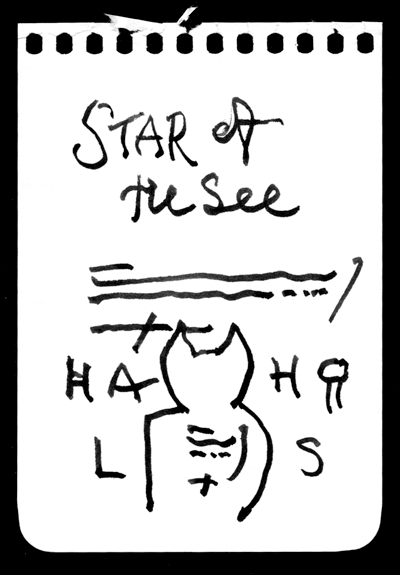
STAR of the See


 First Sight : Susie sees the see
 Originally reproduced 2007.


Susie of Theatre of The Actors of Regard  
“We shall not cease from exploration
And the end of all our exploring
Will be to arrive where we started
And know the place for the first time.
Through the unknown, remembered gate
When the last of earth left to discover
Is that which was the beginning;
At the source of the longest river
The voice of the hidden waterfall
And the children in the apple-tree
Not known, because not looked for
But heard, half-heard, in the stillness
Between two waves of the sea.

T.S. Eliot, from “Little Gidding,” Four Quartets
Originally published 1943.

Susie of Theatre of The Actors of Regard  

Theatre of The Actors of Regard  
detail
A Person Looks At A Work Of Art/
someone looks at something...
  
LOGOS/HA HA

Post Scriptus :
from The Coodabeens this morning :

- Torch McGee : "Next caller. Go ahead please."
- Hayden from Glenferrie : "Hi Guy."
- Who's this?
- Hayden here.
- And where are you calling from?
- Glenferrie.
- Oh, yes, and...
- Not too far from Glenferrie Oval, Hallowed Park of Victories Past, I'd say...
   (... some while on ...)
At Law, we have a saying : NON VOLTUS VIDERE. MAGNA CLASSUS CRUSTUM FORMANIS :   (translates) Don't look; see!* But, more importantly, shut your pie hole.

*after John Kennedy Snr (Legendary Coach of Hawthorn) :
In the 1975 VFL Grand Final against North Melbourne, his exhortation to the Hawthorn players at half-time was: "At least do something! Do! Don't think, Mick! Don't hope; do! At least you can come off and say, 'I did this, I shepherded, I played on. At least I did something." Despite this, his team still lost convincingly.[4] - Wikipedia

See that oration here :


12 February 2021

Year of the Iron Oxide


A patch of rusTAR metal, showing through cracked and flaking paint.

Theatre of the Actors of Regard  
 detail
 A Person Looks At A Work Of Art/
 someone looks at something...
  
 LOGOS/HA HA


26 October 2020

recto TAR verso


We screen-snapped this image some while back, but didn't make notes. Was it by Ike Taiga? 


It intrigues in the manner of  Rene Magritte's Not to Be Reproduced (La reproduction interdite), 1937.


Today, a view from the meta-side.

Theatre of the Actors of Regard  
  detail
  A Person Looks At A Work Of Art/
  someone looks at something...
  
  LOGOS/HA HA


19 October 2020

Ring (TAR)


 "I mean whatever you mean." The Ring (USA 2002)


Theatre of the Actors of Ring  
 detail
 A Person Looks At A Work Of Art/
 someone looks at something...
  
 LOGOS/HA HA


03 May 2020

half and half

  
  Half a pound of twopenny rice,
  Half a pound of treacle,
  That's the way this ditty rolls
  Pop! goes the weasel.
  

  Daruma, Hakuin Ekaku (1685–1768)            collection FIAPCE

  Up and down the City Road
  In and out the Eagle
  That's the way this ditty rolls
  Pop! goes the weasel.


Theatre of the Actors of Regard   
 detail
 A Person Looks At A Work Of Art/
 someone looks at something...
  
 LOGOS/HA HA


10 February 2020

Towards Another Repaint, but first...


Towards Another Restoration, Hosier Lane, Melborne  

Theatre of the Actors of Regard  
 detail
 A Person Looks At A Work Of Art/
 someone looks at something...
  
 LOGOS/HA HA


20 August 2019

a void pissing in the wind


We recently read the Jacquelynn Baas essay
Before Zen : The Nothing of American Dada with it's further consideration of the ...Duchamp/Mutt/
Wood/Steiglitz/Norton... 'Fountain'.

Alfred Stieglitz, photograph of Marcel Duchamp’s Fountain, as published in Beatrice Wood, The Blind Man, No. 2, May 1917. 
Philadelphia Museum of Art, The Louise and Walter Arensberg Collection.

Then, Buddha of the Bathroom by Louise Norton (1917). Here's an extract :

When the jurors of The Society of Independent Artists firmly rushed to remove the bit of sculpture called the Fountain sent in by Richard Mutt, because the object was irrevocably associated in their atavistic minds with a certain natural function of a secretive sort.
  
Yet to any ‘innocent’ eye how pleasant is its chaste simplicity of line and color! Someone said, ‘Like a lovely Buddha’; someone said, ‘Like the legs of the ladies by Cézanne’; but have they not, those ladies, in their long, round nudity always recalled to your mind the calm curves of decadent plumbers’ porcelains?
At least as a touchstone of Art how valuable it might have been! If it be true, as Gertrude Stein says, that pictures that are right stay right, consider, please, on one side of a work of art with excellent references from the Past, the Fountain, and on the other almost anyone of the majority of pictures now blushing along the miles of wall in the Grand Central Palace of ART. Do you see what I mean?
And more such (from wikipedia) :

In a letter dated 23 April 1917, Stieglitz wrote of the photograph he took of Fountain: "The "Urinal" photograph is really quite a wonder—Everyone who has seen it thinks it beautiful—And it's true—it is. It has an oriental look about it—a cross between a Buddha and a Veiled Woman."[2][25]

In 1918, Mercure de France published an article attributed to Guillaume Apollinaire stating Fountain, originally titled 
"le Bouddha de la salle de bain" (Buddha of the bathroom), represented a sitting Buddha.[26] 
. . . .
Since the photograph taken by Stieglitz is the only image of the original sculpture, there are some interpretations of Fountain by looking not only at reproductions but this particular photograph. Tomkins notes
"Arensberg had referred to a 'lovely form' and it does not take much stretching of the imagination to see in the upside-down urinal's gently flowing curves the veiled head of a classic Renaissance Madonna or a seated Buddha or, perhaps more to the point, one of Brâncuși's polished erotic forms."[1][42]
 
It all reminded us of this 'wall-gazing Daruma' scroll by the Zen master Nantembō (1839–1925).

collection : FIAPCE  

The inscription as translated by John Stevens : 

        The form of our Grand patriarch 
             facing the wall in meditation
        or is it a tasty melon or an eggplant 
             from around here in Yahata?
        (signed) 
             Eighty-five-year-old Nantembo Toju


Theatre of the Actors of Regard  
 detail
 A Person Looks At A Work Of Art/
 someone looks at something... 
         
 LOGOS/HA HA


04 August 2019

Archetypes of TAR


Theatre of the Actors of Regard in classic tableau, below, at the Tate Modern's recently opened
ARTIST ROOMS : Ed Ruscha.


photo by Tate Photography/Oliver Cowling  
The TARchetype, GeniTAR Prime :

Theatre of the Archetypes of Regard  
 detail
 A Person Looks At A Work Of Art/
 someone looks at something... 
         
 LOGOS/HA HA


23 June 2019

SLOW-LOOK v. Theatre of the AcceleraTARTARTARTARTARTARTARTARs of Regard


We appreciated this morning's ABC.RN Mine Field discussion of "slow journalism" en regard :

What if the greatest threat to a free media was from within?

Our lives are saturated with 'news'; but far from creating informed citizens, this is producing forgetful, inattentive citizens. Megan Le Masurier joins us to discuss whether "slow journalism" could help us remember what matters?


Last week we discussed the moral and political principles laid bare by the Australian Federal Police’s raids on the home of a News Corp journalist and the Sydney offices of the ABC. But such external threats to the 'free' press are not the only, or even the most dire, threats to the proper functioning of the media in a healthy democracy.

The threat posed by the AFP raids is the threat feared by George Orwell: external pressure, obfuscation or intimidation by a censorious, overbearing, totalitarian state. But there was another threat, no less real, articulated by Aldous Huxley: there is no need for the state to censor the truth, when the 'capitalist propaganda industry' can simply bury the truth in an avalanche of the trivial, the salacious and the manufactured. Why censor the truth, when over time people can no longer tell the difference between the true, the trivial and the manufactured? Then throw speed and the ubiquity of smart phones into the mix, and you have the makings of a democratic catastrophe.

Under conditions of speed, of instantaneity, and information overload, can journalism still fulfil its ethical vocation?


Following upon that came this email text and image from QAGOMA :

TOUR: SLOW-LOOK
1.30pm, Sun 30 Jun
GOMA | Free

Look slowly and closely at one artwork by Margaret Olley and Ben Quilty with QAGOMA curators and discover connections between the artist’s work and lives. Auslan interpreted.


    Theatre of the Actors of Regard  
 detail
 A Person Looks At A Work Of Art/
 someone looks at something... 
         
 LOGOS/HA HA


22 March 2019

360koan : Daruma on a board


Daruma Crossing the River on a Reed
Fūgai Ekun (1568-1654) 


click image to enlarge  
  detail
  A Person Looks At A Work Of Art/
  someone looks at something... 
         
  LOGOS/HA HA


19 February 2019

andscape and traveller ] at rest (


click images to enlarge  

Theatre of the Actors of Regard  
 detail
 A Person Looks At A Work Of Art/
 someone looks at something... 
         
 LOGOS/HA HA


15 January 2018

- ] my ] ] moebius (( bias ( -


The Fosterville Institute of Applied & Progressive Cultural Experience has directed our attention to this article by Michel Bitbol at Academia.edu :

From :
The Monastery and the Microscope
Conversations with the Dalai Lama on Mind, Mindfulness, and the Nature of Reality
Edited by W. Hasenkamp & Janna White
Yale University Press, 2017


Chapter 7:
A Strange Loop of Relations: Phenomenology and experience. A study of consciousness (Michel Bitbol, PhD)

Scientific research and methods have traditionally supported the idea that the brain is the cause of consciousness. Michel argues, however, that the relationship is mutual and grounded in experience, creating a “strange loop of relations” where experience is primary, and the brain itself can be both an object of, and a basis for, experience. The subsequent discussion is an example of excellent interdisciplinary dialogue, with a vigorous and collegial debate about how much the materialist view can really tell us about conscious experience.

From that published article, this extract taster :

A Brain Seeing a Brain

Michel Bitbol : ...If we accept that, then the complete picture changes. We no longer have a one-way relation between the brain, which is basic, and consciousness, which is derivative. Instead we have a mutual relation between them. Moreover, their mutual relation is itself understood as a fact of experience. We have what I would like to call the strange loop of the relations between the brain and consciousness ; but a strange loop that is itself a fact of consciousness.

This strange loop was wonderfully expressed by Bertrand Russell, the great British philosopher of the 20th century. Russell said, “Men will urge that a mind is dependent upon the brain, or, with equal plausibility, that the brain is dependent upon the mind.” (14) Why did he say that? We know that there are experiments that show various correlations between the brain and the mind, and we know that we can trigger mental activities and experiences by stimulating the brain. Therefore we say that the mind might be dependent up on the brain. But we know also: (i) that we can transform the brain by mental training, and (ii) that the brain is an object of our experience. Therefore the brain is somehow also dependent upon the mind. The relation is mutual.

  
14 Bertrand Russell, Mysticism and Logic: And Other Essays 
(New York: Longmans,Green and Co, 1919), 136.


Figure 7.3
The strange loop of relations. At the left is an image of a brain that is seen by a person’s eye, which is connected to his or her brain. Thus, a representation of the small brain exists in the visual cortex of the person’s brain(right). Michel emphasizes the difference between our knowledge of the process of the brain “seeing” this figure, and the raw experience of seeing.


Let’s make a little thought experiment together about this strange loop. 

We see a wonderful thing on this picture (figure 7.3). We see a brain that is seen by an eye. The eye is the eye of somebody who has a brain. Therefore the picture of the brain is projected on the back of his or her brain cortex (the occipital cortex), and the person sees the brain.

We are now seeing a brain that is seeing a brain. But please notice that we are all outside the picture. Now, who is seeing the picture of a brain that is seeing a brain at this very moment? If I wait a little bit I’m sure somebody will tell me, “Oh it’s my brain that is seeing the brain that is seeing the brain.” Maybe. But to say this, you have to think for a few seconds. Initially, and immediately, all you had is an experience, your experience of seeing. When I stop and ask you who is seeing the brain that is seeing the brain, you first dwell in your experience and then make inferences from there to say that it is your brain. But even that belief — that it is your brain that is seeing the brain that is seeing the brain — is here and now a conscious experience. You see? At the present end of the series of visual perceptions, inferences, thoughts, and beliefs, there is an experience: an experience of perceiving, thinking, believing, but an experience in every case. Even your belief that your experience is underpinned by your brain is a present experience of yours!

What I am trying to do is bring you back to what you are now, at this very precise moment, not a thinker but an experiencer — an experiencer even of the thinking, an experiencer even of the idea that experience is underpinned by a brain. What there is now is experience, nothing else but experience. You believe that this is not the case, that there is now something other than experience? But even this belief is an experience!


- - ] - - - - ( - - 


FIAPCE  -1978-1985-  
  detail
  A Person Looks At A Work Of Art/
  someone looks at something... 
         
  LOGOS/HA HA


20 December 2017

TAR gaze


Perspectives on art and feminism 
Australian Centre for Contemporary Art

Melbourne
15 Dec 2017–25 Mar 2018
 
Nat and Ali | Hayley Arjona | Gillian Armstrong | Atong Atem | Cigdem Aydemir | Ali Gumillya Baker | Frances Barrett | Archie Barry | Vivienne Binns | Hannah Brontë | Madison Bycroft | Barbara Campbell | Sadie Chandler | Barbara Cleveland | Essie Coffey | Lip Collective | Megan Cope | Emma-Kate Croghan | Kate Daw | Linda Dement | Narelle Desmond | Sue Dodd | Kelly Doley | Hannah Donnelly | Mikala Dwyer | Jackie Wolf aka Jackie Farkas | Emily Floyd and Mary Featherston | Hissy Fit | Fiona FoleyDestiny Deacon and Virginia FraserSarah Goffman | Elizabeth GowerHelen Grace | Natalie Harkin | Sandra Hill | Another Planet Posters Inc. | Soda Jerk | Jillposters | Lyndal Jones | Kate Just | Deborah Kelly | The Kingpins | Maria Kozic | LEVEL | Samantha Lang | Eugenia Lim | Linda Marrinon | Janet Burchill and Jennifer McCamley | Megan McMurchy | Spence Messih | Tracey Moffatt | Margot Nash | Ann Newmarch | Claudia Nicholson | Técha Noble | Margot Oliver | Ruth O’Leary | Monica Pellizzari | Frances (Budden) Phoenix | Patricia Piccinini | Art Theory Productions | FRAN FEST Poster Project | The Cross Art Projects | Elizabeth Pulie | Clare Rae | Hannah Raisin | Virginia Fraser and Elvis Richardson | Alex Martinis Roe | Jacinta Schreuder | Tai Snaith | Linda Sproul | Giselle Stanborough | Embittered Swish | Desiree Tahiri | Sophie Takách | Salote Tawale | Natalie Thomas | Jeni Thornley | Lyndal Walker | Sarah Watt | Shevaun Wright

installation view photo by Jacqui Shelton 


Theatre of the Actors of Regard  
 detail
 A Person Looks At A Work Of Art/
 someone looks at something... 
         
 LOGOS/HA HA