David Jones, artist and poet (1895-1974) begins his PREFACE TO THE ANATHEMATA :
'I have made a heap of all that I could find.' (1) So wrote Nennius, or whoever composed the introductory matter to Historia Brittonum. He speaks of an 'inward wound' which was caused by the fear that certain things dear to him 'should be like smoke dissipated'. Further, he says, 'not trusting my own learning, which is none at all, but partly from writings and monuments of the ancient inhabitants of Britain, partly from the annals of the Romans and the chronicles of the sacred fathers, Isidore, Hieronymous, Prosper, Eusebius and from the histories of the Scots and Saxons although our enemies . . . I have lispingly put together this . . . about past transactions, that [this material] might not be trodden under foot'. (2)
(1) The actual words are coacervavi omne quod inveni, and occur in Prologue 2 to the Historia.
(2) Quoted from the translation of Prologue 1. See The Works of Gildas and Nennius, J.A.Giles, London 1841.
"Sweep away thoughts!" means one must do zazen. Once thoughts are quieted, the Original Face appears. Thoughts can be compared to clouds. When clouds vanish, the moon appears. The moon of suchness is the Original Face. Thoughts are also like the fogging of a mirror. When you wipe away all condensation, a mirror reflects clearly. Quiet your thoughts and behold your Original Face before you were born!
— Daito
Cease practice based
On intellectual understanding,
Pursuing words and
Following after speech.
Learn the backward
Step that turns
Your light inward
To illuminate within.
Body and mind of themselves
Will drop away
And your original face will be manifest.
— Dogen
You cannot describe it or draw it,
You cannot praise it enough or perceive it.
No place can be found in which
To put the Original Face;
It will not disappear even
When the universe is destroyed.
— Mumon
Theatre of the Actors of Regard
detail
A Person Looks At A Work Of Art/
someone looks at something...
LOGOS/HA HA
Theatre of the Actors of Regard
presents
"Holy ... holy ...
holy."
] haec sacra mundi /
these sacred things of the world (
from
'The Analects of Robin' 
detail
A Person Looks At A Work Of Art/
someone looks at something...
LOGOS/HA HA
We first saw Glenda Jackson as Charlotte Corday in the early 1970s, in Peter Brooks 1967 film of 'The Persecution and Assassination of Jean-Paul Marat as Performed by the Inmates of the Asylum of Charenton Under the Direction of the Marquis de Sade'.
The title is usually shortened to Marat/Sade, after a 1963 play by Peter Weiss. She, the film, the play (we even bought the Peter Weiss script) all impressed greatly.
Theatre of the Actors of Regard ] TAR ( has its beginnings t/hereabouts.
Jackson quit acting in 1991 to concentrate on politics – she had joined the Labour Party at 16. In 1992 she was elected as a Labour member to the House of Commons in the UK Parliament where she remained for 23 years, before retiring at age 79.
Theatre of the Assemblies of RepresenTARtives
detail
A Person Looks At A Work Of Art/
someone looks at something...
LOGOS/HA HA

detail
A Person Looks At A Work Of Art/
someone looks at something...
LOGOS/HA HA
‘The Persecution and Assassination of Pierre Bonnard as Performed by the Inmates of the Asylum of TAR Under the Direction of the Marquis de TAR’, usually shortened to Bonnard/TAR (pronounced : bon-ah-TAR), after a 1963 play by Peter Weiss.

detail
A Person Looks At A Work Of Art/
someone looks at something...
LOGOS/HA HA
Theatre of the Actors of Regard
present
detail
A Person Looks At A Work Of Art/
someone looks at something...
LOGOS/HA HA
* The female gaze is a feminist theory term referring to the gaze of the female spectator, character or director of an artistic work, but more than the gender it is an issue of representing women as subjects having agency. As such all genders can create films with a female gaze. Wikipedia
Theatre of the Actors of Regard
detail
A Person Looks At A Work Of Art/
someone looks at something...
LOGOS/HA HA
Who are You: Australian PortraitureNational Gallery of Victoria | The Ian Potter Centre:
NGV Australia 23 Jun - 1 Aug 2022
Self-portrait
see : First catch your self.
A proverbial warning against overconfidence, often thought to have originated in a recipe for hare soup in Mrs Glasse’s The Art of Cookery Made Plain and Easy (1747) or Mrs Beeton’s Book of Household Management (1851). It does not appear in either book, although Mrs Glasse’s book does have the instruction ‘Take your hare when it is cased [=skinned].’ In more general terms, this appears to be a common formulation. The Spirit of Farmers’ Museum (1801) has: ‘How to dress a dolphin, first catch a dolphin.’
A source from a much earlier period, the medieval Latin treatise De legibus et consuetudinibus Angliae, traditionally attributed to the lawyer Henry of Bratton, has the sentence, ‘It is commonly said that one must first catch the deer, and afterwards, when he has been caught, skin him.’
The self is an individual as the object of its own reflective consciousness. Since the self is a reference by a subject to the same subject, this reference ...
Self – individuality, from one's own perspective. To each person, self is that ...
memo : A memorandum (abbrev.: memo; from the Latin memorandum est, "It must be remembered") is a written message that is typically used in a professional setting. Commonly abbreviated "memo," these messages are usually brief and are designed to be easily and quickly understood.
Rex writes :
... Equally, in Who Are You, in an insightful and quite moving selection, the curators include John Nixon’s Self Portrait (Non-Objective Composition) (Yellow Cross) (1990) at the entrance to the fourth room of the show. It’s a cross that now serves, of course, as something of a memorial to Nixon, who died in 2020. In fact, we would suggest, after an initial avant-garde moment inspired by Communism and the Russian Suprematists, sometime in the early ’90s Nixon pursued an equally radical “immanence”: his work is not any more about changing the world but preserving it. The one-day shows, the artist-run spaces, the collaborations, the incessant productivity: Nixon’s practice operates as much as anything as a kind of diary that sought to record or better embody the circumstances in which it was originally made and exhibited. It was just the little art world that gathered around it: Melbourne in the ’90s, 2000s, and 2010s. The different dispositions of similar-looking objects were the attempt to hold together a fragile and precarious moment in time, of which Nixon was the centre. And it is exactly in this sense that Nixon’s works are self-portraits or autobiographical, the very image of his life. He just is his work.
But again—and this is perhaps the real memorial that Nixon’s work now represents—the function of art as a record of its time, its place, its people, as any kind of image of who we are, is coming to an end. The true equivalent to Nixon’s work today—think here of someone like Peter Tyndall—is keeping a blog, posting on Instagram or tweeting with its potentially limitless subscribers.
see also : self-portrait as
detail
A Person Looks At A Work Of Art/
someone looks at something...
LOGOS/HA HA

Smiling girl, a Courtesan holding an obscene image, by
Gerard van Honthorst (1625)

Theatre of the Actors of Regard
detail
A Person Looks At A Work Of Art/
someone looks at something...
LOGOS/HA HA


Theatre of the Actualisation of Regard
detail
A Person Looks At A Work Of Art/
someone looks at something...
LOGOS/HA HA
Yesterday :
Ouroborology : a quantum wave as a mythical snake.
Today :
The Chan Master as Ilusionist : Zhongfeng Mingbe's Huanzhu Jiaxun
by NATASHA HELLER
University of Califonia, Los Angeles
One day when the illusory man was occupying an illusory room,
resting on an illusory seat and grasping an illusory whisk, his
illusory disciples came and gathered like a cloud. Someone asked,
"Why is the pine tree straight? Why are brambles crooked? Why
is the swan white and the crow black?"
- Tianmu Zhonfeng heshang guanglu
WHEN THE YUAN-DYNASTY monk Zhongfeng Mingben ( 1263-1323), or his literary stand-in, "the illusory man" (huanren), picked up what he termed his "illusory whisk" (huanfu) at
the beginning of his "Huanzhu Jiaxun" (The family instructions of "Illusory Abiding"), he evoked the performance of the Chan
master and the intellectual history of the metaphor "illusion." ...
Theatre of the Actors of Regard
detail
A Person Looks At A Work Of Art/
someone looks at something...
LOGOS/HA HA

definition : in a "dictionary", "letters" linked to (verb e.g. "produce") "words"; "words" and their "meanings" linked to (verb e.g. "realise/realize/
real-eyes") a "definition".e.g.
"Unsheathe your dagger definitions. Horseness is the whatness of allhorse."
(James Joyce, Ulysses)

Physics, Art, Mathematics, Science: Hidden Connections. A conference marking Sir Michael Berry’s 75th Birthday
By Maggie Simmons on April 19, 2016
Sir Michael Berry, IOP Publishing’s most prolific author, and long-time Editorial Board member on JPhysA, had a conference held in his honour on Friday 1 April 2016. This was a joint celebration of not only his 75th birthday, but also 50 years of working at the University of Bristol. Colleagues and friends gathered for the occasion and shared their fond memories of not only his academic achievements, but also his diverse range of interests and supportive nature. Here are some of the highlights:
Berry’s Law : ‘nothing is ever discovered for the first time’
Professor Eric Heller described his pleasant drive across the English countryside with Michael. This sedate outing rapidly picked up pace when Eric mentioned he may have read a paper describing something similar to the Berry Phase. Michael promptly accelerated from 90-130 km/h as he had plans in the evening and wanted to read this paper as soon as possible. The pleasant drive may have reached a rapid end, but Eric emphasised Michael’s continuous support and encouragement for him, despite them technically being in ‘competition’.
Ouroborology : a quantum wave as a mythical snake.
Professor Jon Keating, Chair of the Heilbronn Institute for Mathematical Research, gave an insight into his thought processes in choosing to apply for a PhD under Michael’s supervision. The high quality of the research was a given, but it was the supportive and conducive atmosphere that tipped the balance. Most importantly was the unconventional nature of Michael – a photo of him in an Indian tunic held a lot of weight.
The decision proved correct and Jon found himself to not be constrained by field in his research; taking, just as Michael does, inspiration from science, art and music. Disappointingly, not all of these themes took off, and the term ‘ouroborology’ coined by Michael for a quantum wave – reflective of the mythical snake ‘ouroboros’ eating its tail – is not commonly used despite appearing in ‘Riemann’s zeta function: a model for quantum chaos?’ (Berry, 1985).
Bores, frogs and rainbows
Dr Matin Durrani, Editor of Physics World, highlighted some of Michael’s more disparate interests. In his own words, he delights in ‘uncovering down-to-earth or dramatic and sometimes beautiful examples of abstract mathematical ideas: the arcane in the mundane’. A long-time contributor to Physics World, Sir Berry is a journalist’s dream as he intertwines expertise in mathematics to natural world phenomena and art to name a few. His love of tidal bores, application of mathematical singularities to rainbows and of course his joint IgNobel for a levitating frog provide ample opportunities for articles of more general interest.
Theatre of the Actors of Regard
detail
A Person Looks At A Work Of Art/
someone looks at something...
LOGOS/HA HA
found meme over 1950s Man Ray photo of Marcel Duchamp
We can't confirm that Duchamp ever said that about ideas, but it did set us to thinking...
Theatre of the Analogies of Regard
detail
A Person Looks At A Work Of Art/
someone looks at something...
LOGOS/HA HA

TARist doing the Hilda af Klint

Theatre of the Actors of Regard
detail
A Person Looks At A Work Of Art/
someone looks at something...
LOGOS/HA HA
It was
The New Chalet
now it is
The Amalfi

Theatre of the Accomodations of Regard
It was
detail
A Person Looks At A Work Of Art/
someone looks at something...
LOGOS/HA HA
now it is
detail
A Person Looks At A Work Of Art/
someone looks at something...
LOGOS/HA HA
Unsheathe your dagger definitions. Horseness is the whatness of allhorse.
- James Joyce, Ulysses (Scylla and Charybdis)
One tries to move on, but wait there's more. This from today's inbox via the auction house Leonard Joel :

Theatre of Antiquarian Regard
detail
A Person Looks At A Work Of Art/
someone looks at something...
LOGOS/HA HA
Further to yesterday's post re. The Sign of the Four comes this cosmic affirmation (sic), this rejoinder from ZOOM in today's email inbox.
We'd like to offer you complimentary access to the 2021
Gartner Magic Quadrant for Meeting Solutions Report,
in which we have been named a Leader. A frictionless unified communications solution is critical to enhance face-to-face meetings, reduce geographical barriers for organizational collaboration, and save time and money by minimizing business travel.
Download the Gartner Magic Quadrant Report to learn the
key strengths and weaknesses of today's top meeting solution providers.
Theatre of the Actors of Regard
detail
A Person Looks At A Work Of Art/
someone looks at something...
LOGOS/HA HA

Theatre of the Actors of Regard
detail
A Person Looks At A Work Of Art/
someone looks at something...
LOGOS/HA HA
This makuri (unmounted/dis-mounted scroll work) is by the master printer-painter Masanobu Okumura (1686-1764). We cannot see the head the face the eyes the mind of the depicted samurai figure, so to caption the scene 'secretive samurai sees the see' would be speculative and limited.

collection FIAPCE
We can note, at least, the rolling white-capped see script and, formally quite different, the angular white-caped cover of the samurai. Co-existing.

Theatre of the Actors of Regard
detail
A Person Looks At A Work Of Art/
someone looks at something...
LOGOS/HA HA
or
Pointing Portrait at the Peak
collection FIAPCE
Sacred Mountain (Mt. Heap)as
Sacred Image (Signed by Sengai) as
Sacred Regard (TAR)

Theatre of the Actors of Regard
detail
A Person Looks At A Work Of Art/
someone looks at something...
LOGOS/HA HA
"Show me your original face before your mother and father were born."
You cannot describe it, you cannot picture it,You cannot admire it, you cannot sense it.
It is your true self, it has nowhere to hide.
When the world is destroyed, it will not be
destroyed.
- Mumon, The Gateless Gate #23 (1288)
Do Not Think Good, Do Not Think Not-Good
. . . .
2021 is the 100th year of the Art Gallery of New South Wales' Archibald Prize for portraiture.
From the 6000 portraits exhibited as finalists over the past century, cold case detectives at AGNSW have identified 100 of these for a Portrait of the Nation two year Tour of Shame : Archie 100
AAA : Art Archive Australia
"There are eight million stories in the naked city. This is one of them."
- NAKED CITY (1958-1963)
Signed Confession :
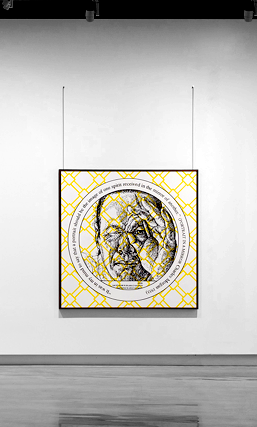
"It was in my mind to say that a portrait should be the image of one spirit received in the mirror of another"
- PORTRAIT IN A MIRROR, Charles Morgan (1933)
Suspended Sentence : TAR co-portrait (-1991-)
Known Associates :
2018.03 Michael Buxton and Charles Justin
collection : Buxton Contemporary, Melbourne
Last seen :
Art Gallery of New South Wales
5 June – 26 September 2021
Geelong Gallery
6 November 2021 – 20 February 2022
Cairns Art Gallery
18 March – 12 June 2022
Art Gallery of South Australia
9 July – 2 October 2022
Queen Victoria Museum and Art Gallery, Launceston
24 October 2022 – 8 January 2023
Bathurst Regional Art Gallery
26 January – 26 March 2023
Museum and Art Gallery of the Northern Territory
15 April – 25 June 2023
Home of the Arts, Gold Coast
15 July – 2 October 2023
National Portrait Gallery, Canberra
21 October 2023 – 28 January 2024
Theatre of the Actors of Regard
detail
A Person Looks At A Work Of Art/
someone looks at something...
LOGOS/HA HA


-800.png)